
The Greatest Gift of All
The ancient world was a landscape forged in iron and blood. Empires rose on the backs of marching armies, and alliances between rulers were typically sealed with gold, elephants, or strategic marriages. But more than two millennia ago, a friendship between two powerful monarchs across the Palk Strait defied the conventions of realpolitik. It resulted in a gift that did not rust, lose value, or fade with time, a gift that completely transformed the cultural, spiritual, and social fabric of Sri Lanka.
On this sacred Poson Full Moon Poya Day, we look back at the extraordinary bond between Emperor Ashoka of India and King Devanampiya Tissa of Anuradhapura, and the timeless lesson it teaches us about the true definition of a gift.
A Friendship Beyond Borders
Long before they ever gazed upon each other’s countenances, Emperor Ashoka and King Tissa were bound by a deep, mutual respect. They were contemporaries ruling over vast domains, yet their connection was nurtured through emissaries who crossed the perilous seas, carrying messages of goodwill and mutual admiration.
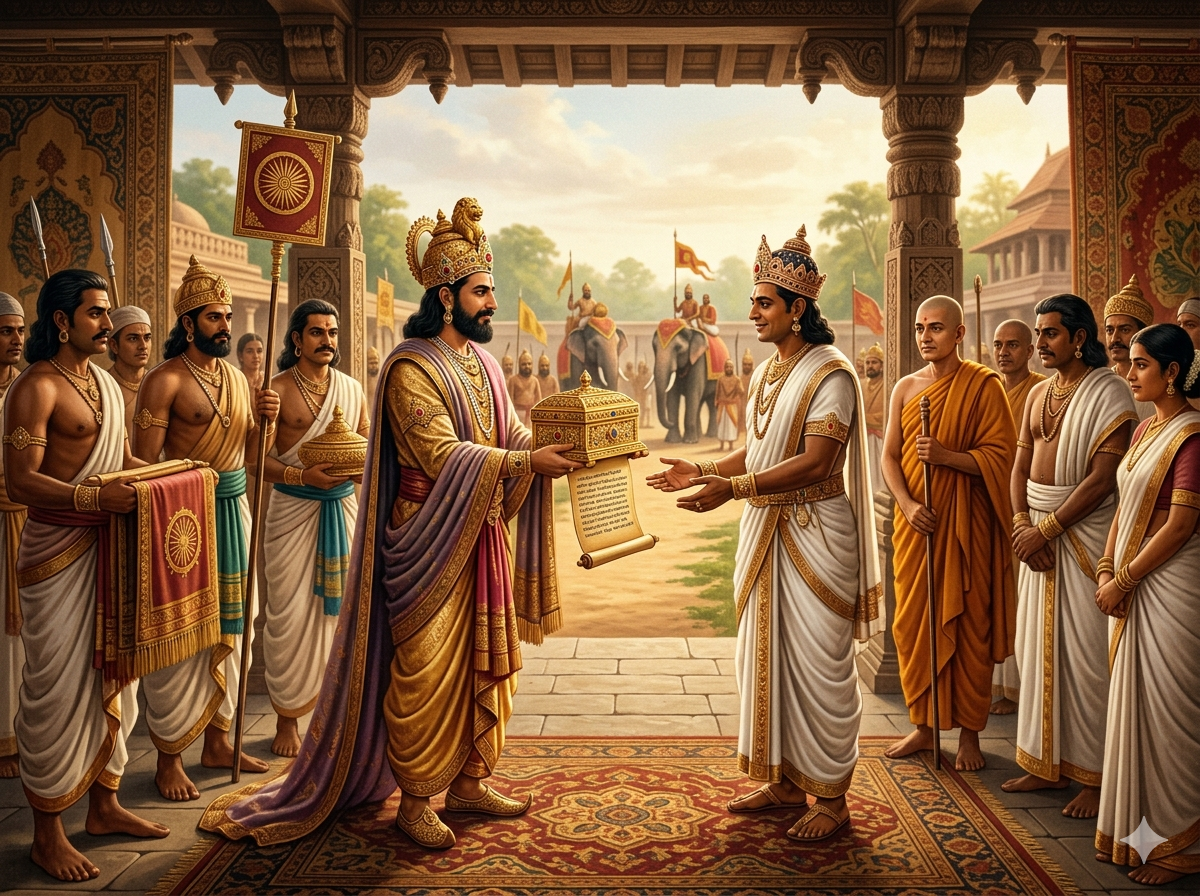
When Tissa ascended the throne in Anuradhapura, one of his first acts of statecraft was to send a grand embassy to the Maurya capital of Pataliputra, laden with the finest treasures of Lanka, exquisite gems, precious pearls, and rare bamboo.
Ashoka, deeply moved by this gesture, responded with unprecedented magnanimity. He sent back not only the royal regalia required for a grand, secondary coronation, elevating Tissa’s status to a truly consecrated sovereign, but also a title that would echo through history: Devanampiya, meaning “Beloved of the Gods.”
Yet, as Ashoka walked the grand courtyards of Pataliputra, surrounded by boundless wealth, a profound restlessness stirred within him. He knew that material wealth was fleeting. He had seen the horrors of the Kalinga War; he had heard the agonizing cries of the dying and the displaced. He had been a warrior king, Chandashoka (Ashoka the Cruel), but that version of him was dead.
Through the serene guidance of the Buddha’s teachings, he had awakened. He had tasted the cooling waters of the Dhamma, transforming into Dharmashoka (Ashoka the Righteous).
Looking at the jewels sent by Tissa, Ashoka pondered a question that challenges every true friend: What is the absolute best gift I can give to someone I hold in the highest esteem?
“The gift of Dhamma excels all gifts; the flavor of Dhamma excels all flavors; the delight in Dhamma excels all delights.”
The Dhammapada (Verse 354)
Ashoka realized that sending gold or horses to Tissa would be like carrying sand to the beach. Tissa was already a king; he had material abundance. If Ashoka truly loved his friend, he had to share the one thing that had brought him inner peace, clarity, and ultimate liberation. He had to gift him the Dhamma.
A Son’s Journey
This was not a gift that could be wrapped in silk or packed in a chest. The Dhamma could only be carried in the hearts and minds of those who lived it. To ensure the message was delivered with the utmost purity and reverence, Ashoka did not send ordinary diplomats. He sent his own flesh and blood, his son, the enlightened Arahant Mahinda, along with a chosen group of scholarly monks.
It was on a full moon day just like today, in the month of Poson, that Arahant Mahinda and his companions materialized atop the granite peaks of Mihintale.
Below them, King Tissa was engaged in a royal deer hunt, pursuing a stag through the thick shrubbery. The hunt was a symbol of the old world; a world of pursuit, capture, and dominance. But the universe had a different design for Lanka that day.
A voice echoed through the trees, calling the king by his bare name:
“Tissa.”
Startled that anyone would dare address a monarch so casually, the king looked up to see the serene, radiant figure of Arahant Mahinda standing on the rock. The monk calmed the king’s initial fear with words that would define the foundational ethos of Sri Lankan civilization:
“Monarch, we are the recluses, disciples of the King of Truth. Out of compassion for you, we have come here from Jambudipa.”
The Awakening at Mihintale
What followed was a beautiful, intellectual meeting of minds. Arahant Mahinda did not demand blind faith or submissive worship; instead, he chose to test the king’s capacity for sharp, analytical thinking. Standing on the rocky plateau, the monk pointed to a nearby tree and initiated history’s first recorded aptitude test: the famous Mango Tree Riddle:
“What is this tree called, O King?” Arahant Mahinda asked.
“It is a mango tree, Venerable Sir.”
“Are there any other mango trees besides this one?”
“There are many other mango trees, Venerable Sir.”
“Are there any trees other than this mango tree and those other mango trees?”
“There are, Sir. There are many trees which are not mango trees.”
“And apart from those mango trees and the trees that are not mango trees, is there any other tree left?”
King Tissa paused, smiled, and replied with absolute clarity:
“There is this mango tree itself, Venerable Sir.”
Arahant Mahinda nodded in approval. He knew then that King Tissa possessed a mind capable of grasping the intricate, layered logic of Buddhist philosophy. He then asked a second riddle about the king’s relatives and strangers, which the king answered with equal brilliance, proving his mind was fertile ground for the profound seeds of the Buddha’s teachings.
Arahant Mahinda then delivered the Chulahatthipadopama Sutta (The Lesser Discourse on the Elephant Footprint Metaphor), using the analogy of tracking a great elephant to explain how one systematically verifies the truth of the Dhamma. As the words washed over King Tissa, the thrill of the hunt vanished. He dropped his bow and arrow. In that singular, luminous moment under the Poson moon, the king and his followers embraced the Triple Gem (the Three Refuges).
The gift had been delivered. The friendship between Ashoka and Tissa had borne the ultimate fruit.
The Living Legacy of a Sacred Exchange
The friendship between Ashoka and Tissa reminds us that the highest form of love and companionship is not found in superficial pleasantries or material exchanges. True friendship is wishing for the spiritual and mental evolution of the other. It is sharing the light when you have found a way out of the darkness.
Because Emperor Ashoka chose to give his best friend his “new knowledge” rather than mere worldly treasures, Sri Lanka became a sanctuary where the Theravada tradition was preserved in its pristine purity for millennia. The landscape of Anuradhapura transformed from a hunting ground into a garden of monasteries, stupas, and reservoirs, built on the pillars of compassion, non-violence, and mindfulness.
Today, as the oil lamps flicker and the white-clad devotees whisper “Sadhu, Sadhu” across the island, we celebrate more than just a historical event. We celebrate an ancient bridge of brotherhood. We celebrate a king who knew how to give, and a king who knew how to receive.
Happy Poson Poya to all. May the light of the Dhamma, passed from friend to friend, continue to illuminate our hearts today and always.
©️Satipatthana Magazine