

In the contemporary discourse on spirituality, reincarnation is frequently viewed through a lens of faith, mysticism, or esoteric lore. However, within the classical traditions of Himalayan Buddhism, the survival of consciousness after physical death is treated not merely as an article of dogma, but as a verifiable truth subject to rigorous logical analysis. When early Tibetan scholars inherited the vast corpus of Indian Buddhist thought, they prioritized a systematic, rational validation of past and future lives. At the heart of this endeavor is the concept of citta-santāna, the unbroken stream of mind, and the philosophical frameworks that prove its rather beginningless and endless nature.
Understand the Nature of the Mind Stream (Citta-Santāna)
To understand how Himalayan Buddhist traditions approach reincarnation, one must first dismantle the misconception of a permanent, unchanging soul (atma or atman). Buddhism rejects the notion of a monolithic ego-entity migrating from body to body. Instead, it posits the existence of a mind-stream (citta-santāna), a dynamic, continuous succession of momentary mental states. Each moment of awareness arises in dependence upon the immediately preceding moment, carrying forward the subtle imprints of karma, habitual tendencies, and wisdom.
 Just as a river appears to be a single, static entity but is actually a constantly changing flow of distinct water droplets, the mind-stream is a fluid continuum of consciousness. Death is not the termination of this process, but a profound transitional phase where the gross levels of sensory awareness dissolve, leaving the subtlest, luminous layer of mind to project forward into a new physical existence.
Dharmakīrti’s Epistemology is a Logical Proof
The definitive philosophical scaffolding for rebirth in the Tibetan tradition relies heavily on the work of the 7th-century Indian master Dharmakīrti, particularly his seminal treatise, the Pramāṇavārttika (translated into Tibetan as Tshad ma rnam ‘grel). Dharmakīrti’s approach is strictly epistemological, utilizing formal logic to demonstrate that consciousness cannot simply vanish into nothingness, nor can it emerge from a completely non-conscious source.
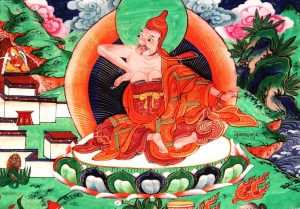 Dharmakīrti’s primary argument rests on the universal law of cause and effect, which states that an effect must be of the same essential nature as its substantial cause. For instance, a rice sprout can only grow from a rice seed; it cannot arise from a pebble or a drop of milk. Applying this law to cognition, Dharmakīrti asserts:
• Matter Cannot Produce Mind
A physical object (the material body or the brain) cannot serve as the substantial cause of subjective awareness. Physical matter is non-conscious, tangible, and possesses spatial extension, whereas consciousness is luminous, cognitive, and non-material. While the physical brain acts as a cooperative condition, shaping how awareness is filtered and expressed in a given lifetime, it cannot generate the primal capacity for experience itself.
• Consciousness Must Arise from Consciousness
Therefore, the substantial cause of any given moment of consciousness must be a preceding moment of consciousness. The very first moment of awareness in a newborn child cannot emerge out of nothing, nor can it be synthesized purely from the biological tissue of the parents. It must have been preceded by a moment of awareness in an intermediate state (bardo or antarabhava), which in turn was linked to the final, dying consciousness (cutta-cittta) of a previous life.
Through this rigorous chain of causality, Himalayan scholasticism demonstrates that the mind-stream has no absolute, identifiable beginning in time, nor can it be utterly destroyed by physical disintegration.
Vasubandhu’s Abhidharma is the Analytical Scaffolding
Complementing Dharmakīrti’s logical deductions is the psychological and cosmological framework provided by Vasubandhu in the 4th-century text, the Abhidharmakośa (Chos mngon pa’i mdzod). Vasubandhu provides the analytical detail of how this continuity manifests during the transition between lives, specifically focusing on the intermediate state (antarābhava or bardo).
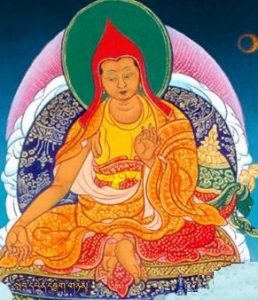 According to the Abhidharma literature, the mind-stream is driven forward by the dual forces of karma (intentional actions) and kleśas (mental afflictions, chiefly ignorance and craving). When the physical body fails, the subtle mental consciousness enters the intermediate state. Vasubandhu describes this state not as a passive vacuum, but as a highly active, fluid phase where the mind, driven by deep-seated karmic propensities, experiences vivid projections.
The continuity is maintained because the subtle mind retains its cognitive capacity. Attracted by the future parents due to specific karmic affinities, the consciousness experiences a moment of craving that serves as the immediate catalyst for its descent into the womb. This analytical model shows that reincarnation is not a random or miraculous intervention, but a predictable, law-bound natural process governed by psychological momentum.
The Mind of Clear Light
In the advanced esoteric systems of the Tantra traditions, which flourished across Tibet’s monastic universities, this continuity is traced to the Prabhāsvara, the primordial ‘Mind of Clear Light’. While ordinary thoughts, emotions, and sensory perceptions are temporary and contingent upon the physical nervous system, ‘the Mind of Clear Light’ is the fundamental, indestructible nature of awareness. It persists through deep sleep, through fainting, and crucially, through the profound dissolution process of death.
 For contemporary readers, this ancient philosophical framework offers a compelling alternative to strict materialistic reductionism. Rather than viewing consciousness as a accidental byproduct of biochemical reactions, the Himalayan sources invite us to see it as a primary, irreducible fabric of reality.
By grounding the reality of rebirth in the immutable laws of cause and effect, the ancient Tibetan sources provide a profound ethical compass. If the mind-stream is continuous, then our current mental cultivation, intentional actions, and development of mindfulness (satipaṭṭhāna) are never lost. They are etched directly into the continuum of the mind, serving as the luminous seeds that will shape our future horizons.
The Guiding Light
Understanding the logical continuity of the mind-stream ultimately serves a higher purpose than mere intellectual satisfaction; it acts as a profound guiding light for how we live today. Because every intention, thought, and action leaves an indelible imprint upon this fluid continuum, our present life becomes the direct workshop in which our future destination is forged. The ancient masters remind us that we need not fear death if we learn to master the present moment. By dedicating ourselves to the daily cultivation of mindfulness (satipaṭṭhāna), rooting out the poisons of greed and aversion, and nurturing a heart of boundless compassion, we purify the very fabric of our consciousness.
 Live this life with an awareness of your ultimate potential, recognizing that every act of kindness and every moment of mental clarity is a luminous seed sown into your eternal mind-stream, ensuring not only a peaceful transition at death, but a radiant and elevated future journey.
©️Satipatthana Magazine