
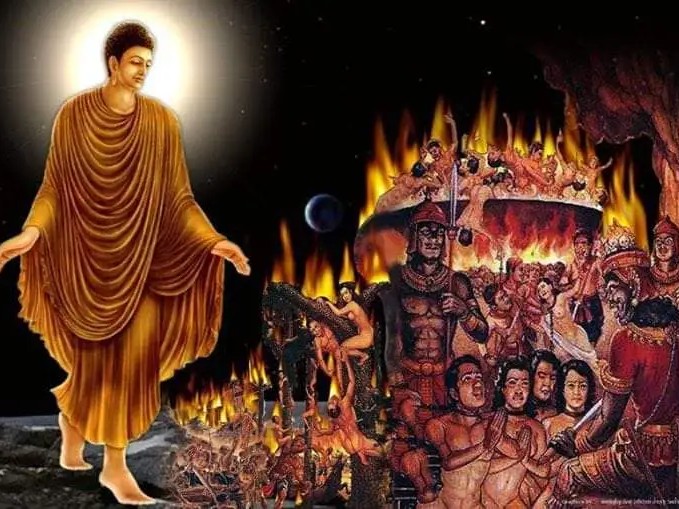
155. Now, the Blessed One has shown that when the unvirtuous have their minds captured by pleasure and satisfaction in the indulgence of the five cords of sense desires, in [receiving] salutation, in being honoured, etc., the result of that kamma, directly visible in all ways, is very violent pain, with that [kamma] as its condition,
capable of producing a gush of hot blood by causing agony of heart with the mere recollection of it. Here is the text:
“Bhikkhus, do you see that great mass of fire burning, blazing and glowing?— Yes, venerable sir.—What do you think, bhikkhus, which is better, that one [gone forth] should sit down or lie down embracing that mass of fire burning, blazing and glowing, or that he should sit down or lie down embracing a warrior-noble maiden or a brahman maiden or a maiden of householder family, with soft, delicate hands and feet?—It would be better, venerable sir, that he should sit down or lie down embracing a warrior-noble maiden … It would be painful, venerable sir, if he sat down or lay down embracing that great mass of fire burning, blazing and glowing.
 156. “I say to you, bhikkhus, I declare to you, bhikkhus, that it would be better for one [gone forth] who is unvirtuous, who is evil-natured, of unclean and suspect habits, secretive of his acts, who is not an ascetic and claims to be one, who does not lead the life of purity and claims to do so, who is rotten within, lecherous, and full of corruption, to sit down or lie down embracing that great mass of fire burning, blazing and glowing. Why is that? By his doing so, bhikkhus, he might come to death or deadly suffering, yet he would not on that account, on the breakup of the body, after death, reappear in states of loss, in an unhappy destiny, in perdition, in hell. But if one who is unvirtuous, evil-natured … and full of corruption, should sit down or lie down embracing a warrior-noble maiden … that would be long for his harm and suffering: on the break-up of the body, after death, he would reappear
in states of loss, in an unhappy destiny, in perdition, in hell” (A IV 128–29).
157. Having thus shown by means of the analogy of the mass of fire the suffering that is bound up with women and has as its condition the indulgence of the five cords of sense desires [by the unvirtuous], to the same intent he showed, by the following similes of the horse-hair rope, the sharp spear, the iron sheet, the iron ball, the iron bed, the iron chair, and the iron cauldron, the pain that has as its condition [acceptance of] homage and reverential salutation, and the use of robes, alms food, bed and chair, and dwelling [by unvirtuous bhikkhus]:
“What do you think, bhikkhus, which is better, that one should have a strong horsehair rope twisted round both legs by a strong man and tightened so that it cut through the outer skin, and having cut through the outer skin it cut through the inner skin, and having cut through the inner skin it cut through the flesh, and having cut through the flesh it cut through the sinews, and having cut through the sinews it cut through the bones, and having cut through the bones it remained crushing the bone marrow—or that he should consent to the homage of great warrior-nobles, great brahmans, great householders?” (A IV 129).
And: “What do you think, bhikkhus, which is better, that one should have a strong man wound one’s breast with a sharp spear tempered in oil—or that he should consent to the reverential salutation of great warrior-nobles, great brahmans, great householders?” (A IV 130). And: “What do you think, bhikkhus, which is better, that one’s body should be wrapped by a strong man in a red-hot iron sheet burning, blazing and glowing— or that he should use robes given out of faith by great warrior-nobles, great brahmans, great householders?” (A IV 130–31).
And: “What do you think, bhikkhus, which is better, that one’s mouth should be prised open by a strong man with red-hot iron tongs burning, blazing and glowing, and that into his mouth should be put a red-hot iron ball burning, blazing and glowing, which burns his lips and burns his mouth and tongue and throat and belly and passes out below carrying with it his bowels and entrails—or that he should use alms food given out of faith by great warrior-nobles …?” (A IV 131–32).
And: “What do you think, bhikkhus, which is better, that one should have a strong man seize him by the head or seize him by the shoulders and seat him or lay him on a red-hot iron bed or iron chair, burning, blazing and glowing—or that he should use a bed or chair given out of faith by great warrior-nobles … ?” (A IV 132–33).
And: “What do you think, bhikkhus, which is better, that one should have a strong man take him feet up and head down and plunge him into a red-hot metal cauldron burning, blazing and glowing, to be boiled there in a swirl of froth, and as he boils in the swirl of froth to be swept now up, now down, and now across—or that he should use a dwelling given out of faith by great warrior-nobles … ?” (A IV 133–34).
What pleasure has a man of broken virtue
Forsaking not sense pleasures, which bear fruit
Of pain more violent even than the pain
In the embracing of a mass of fire?
What pleasure has he in accepting homage
Who, having failed in virtue, must partake
Of pain that will excel in agony
The crushing of his legs with horse-hair ropes?
What pleasure has a man devoid of virtue
Accepting salutations of the faithful,
Which is the cause of pain acuter still
Than pain produced by stabbing with a spear?
What is the pleasure in the use of garments
For one without restraint, whereby in hell
He will for long be forced to undergo
The contact of the blazing iron sheet?
Although to him his alms food may seem tasty,
Who has no virtue, it is direst poison,
Because of which he surely will be made
For long to swallow burning iron balls.
And when the virtueless make use of couches
And chairs, though reckoned pleasing, it is pain
Because they will be tortured long indeed
On red-hot blazing iron beds and chairs.
Then what delight is there for one unvirtuous
Inhabiting a dwelling given in faith,
Since for that reason he will have to dwell
Shut up inside a blazing iron pan?
The Teacher of the world, in him condemning,
Described him in these terms: “Of suspect habits,
Full of corruption, lecherous as well,
By nature evil, rotten too within.”
So out upon the life of him abiding
Without restraint, of him that wears the guise
Of the ascetic that he will not be,
And damages and undermines himself!
What is the life he leads, since any person,
No matter who, with virtue to his credit
Avoids it here, as those that would look well
Keep far away from dung or from a corpse?
He is not free from any sort of terror,
Though free enough from pleasure of attainment;
While heaven’s door is bolted fast against him,
He is well set upon the road to hell.
Who else if not one destitute of virtue
More fit to be the object of compassion?
Many indeed and grave are the defects
That brand a man neglectful of his virtue.
Seeing danger in the failure of virtue should be understood as reviewing in such ways as these. And seeing benefits in perfected virtue should be understood in the opposite sense.
By Bhikkhu Ñānamoli