
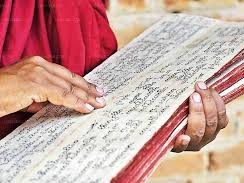
This done, he set sail in a ship for Sri Lanka. The Maháthera Buddhadatta had set sail that day from Sri Lanka for India. The two ships met by the intervention of Sakka Ruler of Gods. When the two elders saw each other, the Elder Buddhaghosa told the other: “The Buddha’s Dispensation has been put into Sinhalese; I shall go and translate it and put it into Magadhan.” The other said, “I was sent to go and translate the Buddha-word and write it in Magadhan. I have only done the Jinálaṅkára, the Dantavaṃsa, the Dhátuvaṃsa and the Bodhivaṃsa, not the commentaries and the sub-commentaries (tīká). If you, sir, are translating the Dispensation from Sinhalese into Magadhan, do the commentaries to the Three Piakas.” Then praising the Elder Buddhaghosa, he gave him the gall-nut, the iron stylus, and the stone given him by Sakka Ruler of Gods, adding, “If you have eye trouble or backache, rub the gall-nut on the stone and wet the place that hurts; then your ailment will vanish.” Then he recited a stanza from his Jinálaṅkára. The other said, “Venerable sir, your book is written in very ornate style. Future clansmen will not be able to follow its meaning. It is hard for simple people to understand it.” “Friend Buddhaghosa, I went to Sri Lanka before you to work on the Blessed One’s Dispensation. But I have little time before me and shall not live long. So, I cannot do it. Do it therefore yourself, and do it well.” Then the two ships separated. Soon after they had completed their voyages the Elder Buddhadatta died and was reborn in the Tusita heaven (Chapter IV).
The Elder Buddhaghosa stayed near the port of Dvijathána in Sri Lanka. While there he saw one-woman water-carrier accidentally break another’s jar, which led to a violent quarrel between them with foul abuse. Knowing that he might be called as a witness, he wrote down what they said in a book. When the case came before the king, the elder was cited as a witness. He sent his notebook, which decided the case. The king then asked to see him (Chapter V).
After this the elder went to pay homage to the Saṅgharája, the senior elder of Sri Lanka. One day while the senior elder was teaching bhikkhus he came upon a difficult point of Abhidhamma that he could not explain. The Elder Buddhaghosa knew its meaning and wrote it on a board after the senior elder had left. Next day it was discovered and then the senior elder suggested that he should teach the Order of Bhikkhus. The reply was: “I have come to translate the Buddha’s Dispensation into Magadhan.” The senior elder told him, “If so, then construe the Three Piþakas upon the text beginning, ‘When a wise man, established well in virtue…’” He began the work that day, the stars being favourable, and wrote very quickly. When finished, he put it aside and went to sleep. Meanwhile Sakka, Ruler of Gods, abstracted the book. The elder awoke, and missing it, he wrote another copy very fast by lamplight then he put it aside and slept. Sakka abstracted that too. The elder awoke, and not seeing his book, he wrote a third copy very fast by lamplight and wrapped it in his robe. Then he slept again. While he was asleep Sakka put the other two books beside him, and when he awoke he found all three copies. He took them to the senior elder and told him what had happened. When they were read over there was no difference even in a single letter. Thereupon the senior elder gave permission for the translating of the Buddha’s Dispensation. From then on the elder was known to the people of Sri Lanka by the name of Buddhaghosa—(Chapter VI).
He was given apartments in the Brazen Palace, of whose seven floors he occupied the lowest. He observed the ascetic practices and was expert in all the scriptures. It was during his stay there that he translated the Buddha’s Dispensation. When on his alms round he saw fallen palm leaves he would pick them up; this was a duty undertaken by him. One day a man who had climbed a palm tree saw him. He left some palm leaves on the ground, watched him pick them up, and then followed him. Afterwards he brought him a gift of food. The elder concluded his writing of the Dispensation in three months. When the rainy season was over and he had completed the Paváraná ceremony, he consigned the books to the senior elder, the Saṅgharája. Then the Elder Buddhaghosa had the books written by Elder Mahinda piled up and burnt near the Great Shrine; the pile was as high as seven elephants. Now that this work was done, and wanting to see his parents, he took his leave before going back to India. Before he left, however, his knowledge of Sanskrit was queried by bhikkhus; but he silenced this by delivering a sermon in the language by the Great Shrine. Then he departed—(Chapter VIII).
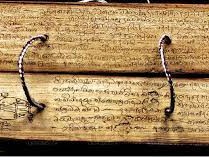 On his return he went to his preceptor and cleared himself of his penance. His parents too forgave him his offences; and when they died they were reborn in the Tusita heaven. He himself, knowing that he would not live much longer, paid homage to his preceptor and went to the Great Enlightenment Tree. Foreseeing his approaching death, he considered thus: “There are three kinds of death: death as cutting off, momentary death, and conventional death. Death as cutting off belongs to those whose cankers are exhausted (and are Arahants). Momentary death is that of each consciousness of the cognitive series beginning with life-continuum consciousness, which arise each immediately on the cessation of the one preceding. Conventional death is that of all (so-called) living beings.16 Mine will be conventional death.” After his death he was reborn in the Tusita heaven in a golden mansion seven leagues broad surrounded with divine nymphs. When the Bodhisatta Metteyya comes to this human world, he will be his disciple. After his cremation his relics were deposited near the Enlightenment Tree and shrines erected over them—(Chapter VIII).
It has already been remarked that the general opinion of European scholars is that where this imaginative tale differs from, or adds to, the Mahávaṁsa’s account it is in legend rather than history. Finally, there is the question of the Talaing Chronicles of Burma, which mention an elder named Buddhaghosa, of brahman stock, who went from Thatõn (the ancient Buddhist stronghold in the Rámaññadesa of Burma) to Sri Lanka (perhaps via India) to translate the Buddha-word into Talaing and bring it back. It is hard to evaluate this tradition on the evidence available; but according to the opinion of the more reliable Western scholars another elder of the same name is involved here.
What can be said of the Visuddhimagga’s author without venturing into unfounded speculation is now exhausted, at least in so far as the restricted scope of this introduction permits. The facts are tantalizingly few. Indeed this, like many scenes in Indian history, has something of the enigmatic transparencies and uncommunicative shadows of a moonlit landscape—at the same time inescapable and ungraspable.
Some answer has, however, been furnished to the two questions: why did he come to Sri Lanka? And why did his work become famous beyond its shores? Trends such as have been outlined, working not quite parallel on the Theraváda of India and Sri Lanka, had evolved a situation favouring a rehabilitation of Pali, and consequently the question was already one of interest not only to Sri Lanka, where the old material was preserved. Again, the author possessed outstandingly just those personal qualities most fitted to the need accuracy, an indefatigable mental orderliness, and insight able to crystallize the vast, unwieldy, accumulated exegesis of the Tipitaka into a coherent workable whole with a dignified vigorous style, respect for authenticity and dislike of speculation, and (in the circumstances not at all paradoxically) preference for self-effacement. The impetus given by him to Pali scholarship left an indelible mark on the centuries that followed, enabling it to survive from then on the Sanskrit siege as well as the continuing schism and the political difficulties and disasters that harassed Sri Lanka before the “Second Renascence.” A long epoch of culture stems from him. His successors in the Great Monastery tradition continued to write in various centres in South India till the 12th century or so, while his own works spread to Burma and beyond. Today in Sri Lanka and South East Asia his authority is as weighty as it ever was and his name is venerated as before.
By Bhikkhu Ñānamoli