
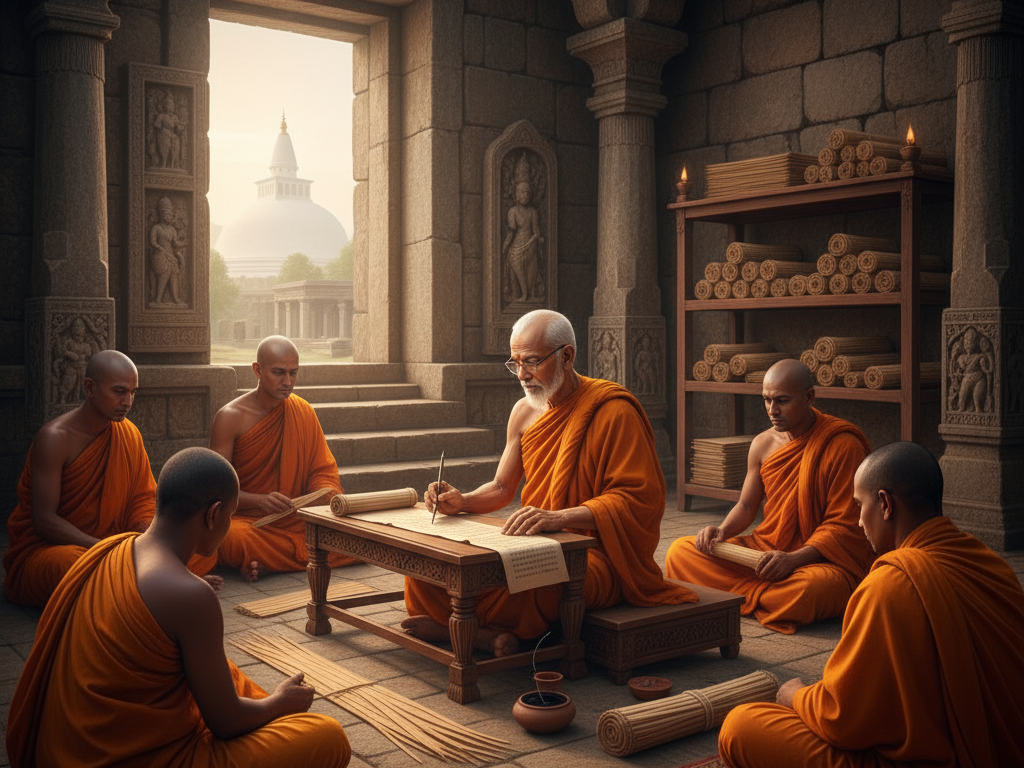
“And when Mahánáma had enjoyed twenty-two years’ reign upon earth and had performed a variety of meritorious works, he passed on according to his deeds”—(Mhv XXXVII.215–47). King Mahánáma is identified with the “King Sirinivása” and the “King Sirikudda” mentioned respectively in the epilogues to the Vinaya and Dhammapada Commentaries. There is no trace, and no other mention anywhere, of the Ñánodaya. The Atthasálinì described as composed in India could not be the version extant today, which cites the Sri Lankan Commentaries and refers to the Visuddhimagga; it will have been revised later. The prologues and epilogues of this author’s works are the only instances in which we can be sure that he is speaking of his own experience and not only simply editing; and while they point only to his residence in South India, they neither confute nor confirm the Mahávaṁsa statement than he was born in Magadha (see note 8). The Sri Lankan Chronicles survived the historical criticism to which they were subjected in the last hundred years. The independent evidence that could be brought to bear supported them, and Western scholars ended by pronouncing them reliable in essentials. The account just quoted is considered to be based on historical fact even if it contains legendary matter.
It is not possible to make use of the body of Bhadantácariya Buddhaghosa’s works to test the Mahávaṁsa’s claim that he was a learned Brahman from central India, and so on. It has been shown already how the presumption is always, where the contrary is not explicitly stated, that he is editing and translating material placed before him rather than displaying his own private knowledge, experience and opinions. And so, it would be a critical mistake to use any such passage in his work for assessing his personal traits; for in them it is, pretty certainly, not him we are dealing with at all but people who lived three or more centuries earlier. Those passages probably tell us merely that he was a scrupulously accurate and conscientious editor. His geographical descriptions are translations, not eyewitness accounts. Then such a sutta passage as that commented on in Chapter I, 86–97 of the present work, which is a part of a sutta used by bhikkhus for daily reflection on the four requisites of the life of a Bhikkhu, is certain to have been fully commented on from the earliest times, so that it would be just such a critical mistake to infer from this comment anything about his abilities as an original commentator, or anything else of a personal nature about him or his own past experience. And again, the controversial subject of the origin of the Brahman caste (see M-a II 418) must have been fully explained from the Buddhist standpoint from the very start. If then that account disagrees with Brahmanical lore—and it would be odd, all things considered, if it did not—there is no justification for concluding on those grounds that the author of the Visuddhimagga was not of Brahman origin and that the Mahávaṁsa is wrong. What does indeed seem improbable is that the authorities of the Great Monastery, resolutely committed to oppose unorthodoxy, would have given him a free hand to “correct” their traditions to accord with Brahmanical texts or with other alien sources, even if he had so wished. Again, the fact that there are allusions to extraneous, non-Buddhist literature (e.g. VII.58; XVI.4 n.2; XVI.85, etc.) hardly affects this issue because they too can have been already in the material he was editing or supplied to him by the elders with whom he was working.
 What might repay careful study are perhaps those things, such as certain Mahayana teachings and names, as well as much Brahmanical philosophy, which he ignores though he must have known about them. This ignoring cannot safely be ascribed to ignorance unless we are sure it was not dictated by policy; and we are not sure at all. His silences (in contrast to the author of the Paramatthamañjúsá) are sometimes notable in this respect.
The “popular novel” called Buddhaghosuppatti, which was composed in Burma by an elder called Mahámaṅgala, perhaps as early as the 15th century, is less dependable. But a survey without some account of it would be incomplete. So here is a précis: Near the Bodhi Tree at Gayá there was a town called Ghosa. Its ruler had a Brahman chaplain called Kesi married to a wife called Kesinì. An elder bhikkhu, who was a friend of Kesi, used to wonder, when the Buddha’s teaching was recited in Sinhalese, and people did not therefore understand it, who would be able to translate it into Magadhan (Páli). He saw that there was the son of a deity living in the Távatiísa heaven, whose name was Ghosa and who was capable of doing it. This deity was persuaded to be reborn in the human world as the son of the Brahman Kesi. He learnt the Vedas. One day he sat down in a place sacred to Vishnu and ate peas. Brahmans angrily rebuked him, but he uttered a stanza, “The pea itself is Vishnu; who is there called Vishnu? And how shall I know which is Vishnu?” and no one could answer him. Then one day while Kesi was instructing the town’s ruler in the Vedas a certain passage puzzled him, but Ghosa wrote down the explanations on a palm leaf, which was found later by his father—(Chapter I).
Once when the elder bhikkhu was invited to Kesi’s house for a meal Ghosa’s mat was given to him to sit on. Ghosa was furious and abused the elder. Then he asked him if he knew the Vedas and any other system. The elder gave a recitation from the Vedas. Then Ghosa asked him for his own system, whereupon the elder expounded the first triad of the Abhidhamma schedule, on profitable, unprofitable, and indeterminate thought-arisings. Ghosa asked who’s the system was. He was told that it was the Buddha’s and that it could only be learnt after becoming a bhikkhu. He accordingly went forth into homelessness as a bhikkhu, and in one month he learned the three Pitakas. After receiving the full admission, he acquired the four discriminations. The name given to him was Buddhaghosa—(Chapter II).
One day the question arose in his mind: “Who has more understanding of the Buddha-word, I or my preceptor?” His preceptor, whose cankers were exhausted, read the thought in his mind and rebuked him, telling him to ask his forgiveness. The pupil was then very afraid, and after asking for forgiveness, he was told that in order to make amends he must go to Sri Lanka and translate the Buddha-word (sic) from Sinhalese into Magadhan. He agreed, but asked that he might first be allowed to convert his father from the Brahman religion to the Buddha’s teaching. In order to achieve this, he had a brick apartment fitted with locks and furnished with food and water. He set a contrivance so that when his father went inside hewas trapped. He then preached to his father on the virtues of the Buddha, and on the pains of hell resulting from wrong belief. After three days his father was converted, and he took the Three Refuges. The son then opened the door and made opened the door and made amends to his father with flowers and such things
for the offence done to him. Kesi became a stream-enterer— (Chapter III).
By Bhikkhu Ñānamoli