

Reflection, as a key phase in action research has been brought into discussion in a broader scale in different levels of actions. Almost every study reveals that any cognitive act is not possible without reflective inquiry. In a very broad sense, reflection is a deliberate and purposeful metacognitive thinking anyone engages in improving their own action materializing in the past, present and future. ‘Reflection’ as a key component in attaining ‘Nibbāna’ has been recommended by the Buddha in several discourses. ‘Abhidhamma’ records five kinds of mastery [javana] with respect to attaining ‘jhāna’. Mastery in reviewing [paccavekkhanavasi] is recommended in reviewing the ‘jhāna’ and its factors by means of retrospective knowledge immediately after adverting to them [Vism., pp.124-25. Ā], which means knowledge gained by looking back on any past action or recalling and any past experience. In ‘Ambalātthika Rāhūlovāda Sutta’ [Majjhima Nikaya’; ‘Sutta Pitaka’; MN. II:61] the Buddha shows his son ‘Rahula’ the importance of ‘reflection’. There he advised ‘Rahula’ to reflect on every physical, verbal and mental action should be done after repeated reflection. ‘Dasadhamma Sutta’ in ‘Anguttara Nikaya’ [AN: 10.48] records another instance where the Buddha showed the importance of reflective thinking. There he showed ten things that one who has gone forth should often reflect upon while providing a splendid example for the Buddhist emphasis on reflective thinking in the process of one’s own self- research. Buddhism highly recommends inquiry by the self into the self. Based on Buddhist teachings advice you to see to yourself before you do an action [reflect for action], while you are doing an action [reflection in action] and after having done the action [reflection on action]. This study recommends the application of Buddhist concepts introduced nearly 2500 years ago in the field of action research in enhancing and upgrading the life of people.
Keywords: Reflection, Metacognitive Thinking, ‘Nibbāna’, Buddhism
 Reflection, as a key phase in action research has been brought into discussion in a broader scale and emphasized the importance of it in carrying out any action since without reflection it would not be possible to do so. Lewin [1946], in coining the term ‘action research’, has pointed out ‘reflection’ as a major phase which do sense making in the research process. Apparently, the notion has been used as ‘reflective thinking’, ‘reflective inquiry’ and ‘reflective practice’ maintaining the consistency of the sense of application. Reflective practice is generally identified as an inquiry method needs to be used in one’s own professional development. Simultaneously understanding one’s own philosophy, analyzing one’s own achievements and failures, motivating changing behavior and understanding the dynamics of one’s immediate environment are always underpinned by reflection. Dewey [1933:3] defines reflection as a cognitive process – ‘the active, persistent and careful consideration of any belief or supposed form of knowledge in the light of the grounds that support it and the further conclusions to which it tends’. Elaborating further, Dewey [1933] distinguishes reflective thinking from every day, routine thinking and specially from impulsive thinking. According to him, routine thinking is a result of natural cohesion to one’s usual practices or tradition. As Calderhead [1989: 44] records based on Dewey’s notion: action taken as a result of reflective thinking was an ‘intelligent action’ because the aspects of the issue had been considered rationally and the practitioner had undergone periods of doubt and uncertainty while working towards finding a solution. Dewey’s [1933] figure [Figure:1] further elaborates the idea;
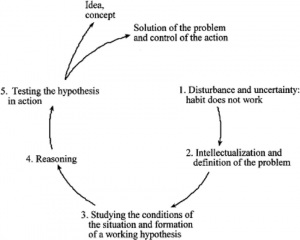 According to Dewey’s depiction, reflection starts due to any disturbance or uncertainty where habits do not work. Thereafter, for intellectualization, defining the problem, studying the conditions of the situation and formation of a working hypothesis and reasoning all require reflection inquiry. In addition, Dewey [1933] has discussed two different mental processes that are both labelled `thought’. In regard to the first thought process he noted that the human brain often engaged in cognitive processes that consisted of mental streams of `uncontrolled coursing of ideas. Dewey maintained that there was another mental stream that was not unlike this random coursing of things through the brain. It differed, however, in that these thought patterns were focused and controlled. Dewey defined these thought patterns as reflective thinking and maintained that their function was to `transform a situation in which there is experienced obscurity, doubt, conflict, disturbance of some sort, into a situation that is clear, coherent, settled, harmonious’ [Dewey,1933 p. 101-102].
Teekman’s [2000] idea further supports the objective of this study: Reflective thinking was extensively manifest, especially in moments of doubt and perplexity, and consisted of such cognitive activities as comparing and contrasting phenomena, recognizing patterns, categorizing perceptions, framing, and self-questioning in order to create meaning and understanding. In addition, within these cognitive processes self- questioning is essential and naturally occurs. Self-questioning is significant within reflective thinking.
Reflective inquiry figures strongly and the concept appears in numerous places in Buddha’s teachings. Once a Buddhist practitioner realizes the importance of reflection, thought is no longer seen as an intrusion or corruption. Reflection which is the axis of investigation is a natural occurrence in the mind and it is a natural aptitude. Reflection is a function of awareness and at the same time helps in discriminating the experiences in improving the cognitive domain. The study intend to reveal the Buddhist recommendation on reflective inquiry which has become a paramount feature of different fields, even in the research field, specially in action research. The concept is not broadly brought into discussion though reflection plays a major role in attaining ‘jhāna’. Therefore, the study aims to grab the attention on the need to address this notion frequently in improving the knowledge of Buddhist practitioners.
 Regardless the definitions given to reflection from different perspectives in the research world, what is to be highlighted in our discussion is the Buddhist recommendation for reflective inquiry. The essence of Buddhist philosophy is based on managing one’s own mental moments. Therefore, as an initiative, the present study tries to reveal the Buddhist recommendation for reflective inquiry in managing one’s own mental moments [citta]. Embarking the discussion with what Calderhead [1989] says: the chain of thoughts occur in the process of reflection can be found in the process of attaining ‘jhāna’ [spiritual heights one obtains in meditation] on the path to the ‘Nibbāna’. Ven. Gunarathana [1980, p.150] records it as: “The commentaries and later analytical treatises of the ‘Theravāda’ tradition connect the process of ‘jhāna’ attainment with the account of the cognitive process ‘cittavīthi’ [cognitive process]. This analysis is presented in the ‘Abhidhamma’. The ‘Abhidhamma’ analyses experience into a succession of discrete, causally connected occasions of consciousness called ‘cittas’ [mental moments] or ‘citt’uppādas’ [arising mental moments].
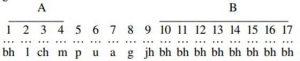
Figure [1]: Thought moments in ‘jhāna’ attainment process [Gunaratana, 1980.p153]
Here line A represent the four great thought moments preceding the ‘jhāna’ process. ‘bh’ [bhavanga] represents’- ceasing of any previous mental moment. ‘l’ its vibration; ‘ch’ – it’s cutting off and ‘m’ – the mind’s advertence to the counterpart sign through the mind-door. Then the preliminary work for the next mental moment starts. This comprises the past stream
of consciousness or the previous cognitive action. And then getting ready to access the new mental moment [jhāna]. ‘Javana’ is described as alacrity, readiness, the stage of full perception or apperception. The first ‘javana’ in this series is called [p] ‘parikamma’ which can be given the meaning ‘preliminary work’. The second is called ‘access’ or [u] ‘upacāra’ [entering the act], the third is [a] ‘anuloma’ [gets qualified further] and the fourth is [g] ‘gotrabhū’ [change of lineage]. Now the practitioner is ready to attain the ‘jhāna’. Once the meditator attains the first ‘jhāna’ he or she has to strive for the second.
Buddha says “After attaining the first ‘jhāna’ a few times the meditator is not advised to set out immediately striving for the second ‘jhāna’. This would be a foolish and profitless spiritual ambition. Before he is prepared to make the second ‘jhāna’, he must first bring the first ‘jhāna’ to perfection”.
In ‘Abhidhamma’ it is recorded that one should acquire five kinds of mastery with respect to the first ‘jhāna’. These masteries are: ‘mastery in adverting’ [Āvajjanavasi] mastery in attaining’ [samāpajjanavasi], ‘mastery in resolving’ [adhitthānavasi], mastery in emerging’[vutthānavasi] and ‘mastery in reviewing’ [paccavekkhanavasi] [Vism., pp.124- ā]. Mastery in adverting is the ability to advert to the ‘jhāna’ factors one by one after emerging from the first ‘jhāna’; the meditator must be able to attend to these factors whenever he wants, and for as long as he wants. Mastery in attainment is the ability to enter upon ‘jhāna’ quickly. Mastery in resolving is the ability to remain in the ‘jhāna’ for exactly the pre-determined length of time. Mastery in emerging is the ability to emerge from the ‘jhāna’ quickly without any difficulty. Mastery in reviewing is reviewing the ‘jhāna’ and its factors by means of retrospective knowledge ‘paccavekkanañāna’ immediately after adverting to them. [‘Paccavekkanañāna’ is used as ‘Prathyavekshathāva’ in Sinhala].
According to many reliable sources, ‘Prathyavekshathāva’ is looking at, consideration, regard, attention, reflection, contemplation, reviewing. Attaining a ‘jhāna’ which is a pinnacle in meditation require reflective inquiry extensively and the Buddha has emphasized on the importance of reflection in attaining ‘Nibbāna’. By reflecting one can gain knowledge by looking back on any past action or recalling and any past experience. Therefore, it is mandatory for the meditator to evaluate and assess the quality of the past experience by recalling them. Based on the evaluation the practitioner can judge whether the achievement is satisfactory or below the expectation.
Gunaratana, H. [1980] has extracted a splendid example from ‘Anguttara Nikāya’: “After attaining the first ‘jhāna’ a few times the meditator is not advised to set out immediately striving for the second ‘jhāna’. This would be a foolish and profitless spiritual ambition. Before he is prepared to make the second ‘jhāna’ the object of his endeavor he must first bring the first ‘jhāna’ to perfection. If he is too eager to reach the second ‘jhāna’ before he has perfected the first he is likely to fail to gain the second ‘jhāna’ and find himself unable to regain the first. The Buddha compares such a meditator to a foolish cow who, while still unfamiliar with her own pasture, sets out for new pasture. She gets lost in the mountains without gaining food or drink and cannot find her way back home” [AN. 4.p.418-19].
 In addition, the interest of the Western scholars about the Buddhist recommendation for reflective inquiry in attaining ‘Nibbāna’ makes a gesture for the need of further studies on this notion. Calderhead [1989] says about the chain of thoughts occur in the process of reflection can be found in the process of attaining ‘jhāna’ [spiritual heights one obtains in meditation] on the path to the ‘Nibbāna’. He says that “It was then intended that this ‘chain’ of thoughts was rigorously examined for any assumptions, underlying beliefs or knowledge
that had been utilized in the formulating of a solution and any evidence that supported these ideas”. Calderhead too [1989.p.44] describes an extensive ideology of Dewy [1933] distinguished reflective thinking from every day, routine thinking and especially from impulsive thinking. Included in his notion of routine thinking was the thinking [and any subsequent actions] that resulted from an individual’s automatic adherence to rules originating from authority or from tradition. He proposed instead that action taken as a result of reflective thinking was ‘intelligent action’, because the aspects of the issue had been considered rationally and the practitioner had undergone periods of doubt and uncertainty while working towards finding a solution. This definition absolutely blends with the mission of attaining ‘Nibbāna’.
At the effort of unwrapping the instances where the Buddha has recommended reflective inquiry, ‘Ambalātthika Rāhūlovāda Sutta’ [Majjhima Nikaya’; ‘Sutta Pitaka’; MN. II:61], ‘Dasadhamma Sutta’ [‘Anguttara Nikaya’; ‘Sutta Pitaka’. AN: 10.48] and ‘Saṅgīthi Sutta’ [‘Digha Nikaya’; ‘Sutta Pitaka’. DN: 33] out of numerous discourses will be taken into consideration.
In ‘Ambalātthika Rāhūlovāda Sutta’ [Majjhima Nikaya’; ‘Sutta Pitaka’; MN. II:61] the discourse between the Buddha and his son [at the time he was a lay person] ‘Rāhūla’ reveals the importance of reflective inquiry. At one point during the discourse, the Buddha asks from the monk: [“Taṃ kimmaññasi rāhula kimatthiyo ādāsoti”] “What do you think, Rahula? What is the purpose of a mirror?”. The Monk replies: [“Paccavekkhanattho bhanteti”] “For the purpose of reflection, venerable sir.” Therefore, the Buddha’s recommendation was to reflect upon one’s own physical, verbal and mental actions before doing. When you reflect, if you know: ‘This action that I wish to do with the body would not lead to my own affliction,
or to the affliction of others, or to the affliction of both; it is a wholesome bodily action with pleasant consequences, with pleasant results/ then you may do such an action with the body.
‘Dasadhamma Sutta’ in ‘Anguttara Nikaya’ [AN: 10.48] records another instance where the Buddha showed the importance of reflective thinking. There the Buddha advised the monks: “Bhikkhus, there are these ten things that one who has gone forth should often reflect upon. What ten?” [“Dasa yime bhikkhave dhamma pabba-jitena abhiṇhaṃ pacc’avekkhītabbā. Katame dasa?”]. Based on the teaching in that ‘sutta’ the Buddha recommends his monks to reflect upon ten things: “One who has gone forth should often reflect upon:
-‘I have entered upon a classless condition
-‘My deportment should be different”
-‘My living is dependent upon others’
-‘Do I reproach myself in regard to virtuous behavior?’
-‘Do my wise fellow monks having investigated, reproach me in regard to virtuous behavior?’
-‘I must be parted and separated from everyone and everything dear and agreeable to me’
-‘Of ‘kamma’ I am constituted. ‘Kamma’ is my inheritance; ‘kamma’ is the matrix; ‘kamma’ is my kinsman; ‘kamma’ is my refuge. Whatever ‘kamma’ I perform, be it good or bad, to that I shall be heir’
-‘How am I spending my nights and days? so that in my last days, when I am questioned by my fellow monks, I will not be embarrassed?’
-‘Do I take delight in empty huts?’
-‘Have I attained any superhuman distinction in knowledge and vision worthy of the noble ones’.
The Buddha has guided his disciples to inquire about the self by the self. Self-learning enables you to learn what you want, when you want and how you want. This is an absolutely a tremendous characteristic of a teacher. At the same time, an excellent guidance for a self- researcher.
The Buddha has preached about three kinds of wisdom in ‘Saṅgıti-Sutta’ [DN.33]. The central importance in the essence of Buddhism is developing wisdom. The three kinds of wisdom are: Wisdom produced by reflection [Cinthāmayā Paññā]; Wisdom produced by hearing [Sutamayā paññā] and wisdom produced by cultivation [Bhāvanāmayā Paññā].
‘Yoniso manasikāra Sampadā Sutta’ [SN.5; Mahāvagga1; Magga Saṁyutta 6; Sūriya Peyyāla 7] is a precise expression of the Buddha found in the ‘Magga Saṁyutta’ the collected discourses on the Noble Eightfold Path. There, the Buddha speaks about two ways in which wrong views arises. One is through listening to others [‘parato ghosa’] without listening to the true ‘Dhamma’, the other one is through unwise attention [‘ayoniso manasikāra’]. Not listening to the true Dhamma allows arising ‘wrong view’ by preventing arising the ‘right view’ and prevents wise faith. Based on that the practitioner will never have any understanding about the true reality. A central term in the ‘Yoniso Manasikāra Sampadā Sutta’ is “wise attention” [yoniso manasikāra] as broadly translated ‘wise reflection’. ‘Yoniso’ comes from ‘yoni’, meaning “the womb, origin [place of birth].” As such, ‘yoniso’ means “down to its origin or foundation” [PED], and ‘manasikāra’ [‘mano’, “mind” → ‘manasi’ [locative] + ‘kara’, “doing, acting, working] means technically mentation, or more simply “direct the mind or attention in a certain way.” Therefore, the term frequently appears in the suttas in the sense of “wise attention, wise reflection” [Tan,P.2007]. ‘Wise reflection’ absolutely combined with causal relationship. The practitioner needs to evaluate the consequences of one’s physical, verbal and mental behavior. In addition, conditioned nature of the phenomena which leads to one’s spiritual development must be explored. This exploration is essential along the Noble Eightfold Path in attaining ‘Nibbāna’ and Buddhist literature refers to it as ‘wise reflection’ and ‘critical reflection’. Through ‘wise reflection’
one sees what is unwholesome as unwholesome, what is impermanent as impermanent and what is unsatisfactory as unsatisfactory. the Buddha has likened wise attention to the dawn that marks the rising of the sun in the morning [‘Yoniso Manasikara Sampadā Sutta’ of the ‘Samyutta Nikaya’].
‘Dawn, Bikkhus, is the forerunner, the harbinger of sun-rise. Even so, Bhikkhus, for a monk this is the forerunner, the harbinger of the arising of the noble eight-fold path, that is, accomplishment in wise attention. Bhikkhus, when a monk is accomplished in this wise attention, it is to be expected that he will cultivate the noble eight-fold path, develop the noble eight-fold path” [Bodhi, B.1999].
 ‘Titthiya Sutta’ [AN. 3.68] explains in the one who pays wise attention or one who practice wise reflection, unrisen passion will not arise, arisen passion will be abandoned, unrisen aversion will not arrive, arisen aversion will be abandoned, un-arisen delusion will not arise and arisen delusion will be abandoned. ‘Ahara Sutta’ [SN. 41.51] is another instance where the Buddha has emphasized the importance of wise reflection.
Continuous emphasizing on the importance of reflection or reflective thought in spiritual practice by the Buddha proves the gravity of it in understanding what is going in mind, distinguishing wholesome and unwholesome activities, evaluating one’s own improvement in spiritual development and in making decisions at the light of new knowledge. Though importance of this concept is not brought into discussion frequently it is an intruder which deliberately manage one’s mental moments. Reflection is a practice which can be used for both wholesome and unwholesome deeds. Therefore, the Buddha’s advice is to engage in reflection wisely. Reflecting wisely, is one of the most important features of a practitioner who is attempting for spiritual heights. On the night of the Buddha’s enlightenment, he was reflecting on ‘Causality’ and ‘Dependent Origination’. This kind of wisely reflecting involves skillful use of thought, not the avoidance. In spite of the fact, reflective inquiry, parallelly to investigation, refers to the quality of the mind. Reflective inquiry is the tool for discerning orders, which looks into things, organizes patterns, what is going on in the mind and what is the nature of the experience. Reflective practice, of course is an exploratory, purposeful, creative pursuit for better knowledge and understanding, and to look systematically and rigorously at one’s own practices [Rolfe, Freshwater & Jasper, 2001].
Reflective practice helps the practitioners to do self-inquiry to enhance their positive thoughts and mange their mental moments. The Buddha who had an extraordinary intelligence knew that reflective inquiry helps problem solving and it should be emphasized in his teachings. He knew that reflective thought as an active, persistent and careful consideration of any belief in light of new knowledge since his advice was not to believe anything blindly but to investigate. According to ‘Kālāma Sūtta’ [‘Angūttara Nikāya’.3.65], the Buddha taught to ‘Kālāma’ princes that they should not believe in a tradition or any teaching due to its antiquity, because they are claimed to be true, through the application of various methods or techniques or its popularity, rather they should call upon the direct knowledge grounded in one’s own experience in critically analyzing the new light of knowledge and verify it against its significance to the human beings. The ‘Kālāmas’ were proposed to avoid passive acceptance but, rather, constant questioning and personal testing underpinned by reflective inquiry.
CONCLUSIONS
The Buddha has highlighted the importance of reflective inquiry significantly in his teachings. In spite of the fact, the concept is not brought into discussion broadly. Reflective inquiry is mentioned as ‘wisely attention’ and ‘wisely reflection’ in Buddhism. Since the utmost outcome of Buddhism is spiritual, wisely reflection is accepted. This leads the practitioner to discriminate own experiences and relate them to wholesome and unwholesome deeds. The wisdom generated through wisely reflection is ‘wisdom through reflection’ or ‘Cinthāmayā Paññā’ in ‘Pāli’. Since reflective practice helps the practitioners to do self-inquiry to enhance their positive thoughts and manage their mental moments, it should be brought into discussion broadly in upgrading and enhancing the standard of people.
© Satipatthana Magazine