
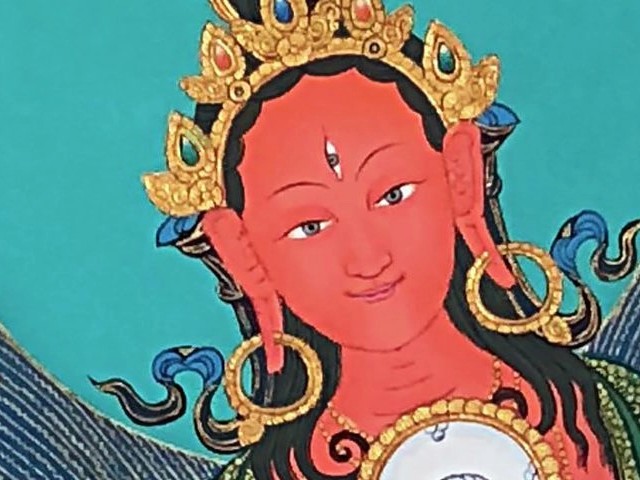
Kandro La is regarded as a significant figure in Tibetan Buddhism. The term Kandro La derives from the Tibetan word for Dakini in Sanskrit, which translates to “the one who moves through the sky” or “sky dancer.” Kandro La, a revered Tibetan nun, embodies the essence of purified feminine strength, representing both the human and the divine. She transcends physical limitations and worldly concerns and symbolizes the depth of spiritual cultivation. The term Kandro also signifies the continuous flow of energy that yogis must align with in their pursuit of spiritual understanding. Femininity, in this context, is not an energy to be suppressed. Women are not inherently lacking in spiritual sensitivity or potential. According to the Buddha, enlightenment which is the highest level of spiritual attainment is equally accessible to women. Buddhahood, the pinnacle of spiritual realization is not confined to any gender. It is a state attainable by anyone with the capacity, training, dedication and inner virtues required. The stereotype that women are weak, unstable, or inferior has no place in Tibetan Buddhism. On the contrary, Tibetan Buddhist tradition recognizes the spiritual potential of women and offer them an equal path toward liberation. That is a fortunate truth for all women on the path of Dharma.
Tibetan Buddhism flourished under the influence of Tantrayāna. The strength of Tantrayāna is so deeply embedded that Tibetan Buddhism inherently reflects its core principles. Tantrayāna employs practical techniques and symbolic rituals to access deeper states of consciousness, making Tibetan Buddhism a vivid expression of Tantric traditions shaped by Tibetan culture, history and spiritual heritage. Tibetan Buddhism can thus be regarded as a guardian of Buddhist philosophy. It goes deeper into and articulates the subtle layers of philosophical inquiry and human wisdom. Tibetan monks (bhikkhus) and nuns (bhikkhunis) are particularly skilled in exploring these depths, often achieving the highest levels of spiritual development through disciplined practice. Buddhist philosophy is intricately linked to the human mind and intellect. Guided by structured practices and spiritual training, Tibetan monastics demonstrate significant mental and behavioral refinement.
According to Mahayāna Buddhism, all sentient beings are born with equal potential. This principle is strongly reflected in Tibetan Buddhism which upholds the belief that every individual possesses the innate capacity to become a Bodhisattva. Such a perspective reinforces the inherent dignity, equality and human values of all beings. Tibetan Buddhism emphasizes that gender is not a barrier to attaining Buddhahood. What truly matters is an individual’s spiritual capacity, dedication and inner development. The rigorous spiritual training undertaken by Tibetan nuns is especially commendable. Tibetan Buddhism recognizes both bhikkhus (monks) and bhikkhunis (nuns) within monastic family structures, illustrating the practical nature of the Mahayāna tradition. Kandro La exemplifies how family life and human relationships do not obstruct spiritual progress. In fact, the wives of Buddhist protectors or spiritual teachers are often known as Dākinis or Kandro La who are symbols of enlightened feminine energy. A Kandro La understands the impermanence of worldly life and strives toward supramundane realization. They are capable of grasping the concept of emptiness and cultivating Bodhicitta, the enlightened mind. The level of one’s mental and intellectual development is often reflected in their understanding of emptiness. Kandro La clearly demonstrate women’s ability to harmonize subtle mental energies and attain deep spiritual insight. Kandro La are living embodiments of compassion and truth and serve as powerful role models on the spiritual path.
Kandro La or Dākini is a revered feminine figure in Tibetan Buddhism. She embodies both spiritual mastery and divine grace. In the Tantrayāna tradition, Kandro La represents the highest form of enlightened femininity. She is a powerful symbol of truth, compassion, and protection. She is the guardian of Tibetan Buddhism, which is deeply rooted in Tantric teachings. Kandro La are seen as messengers of wisdom and agents of spiritual purification. They serve as protectors of the pure Dhamma. They work to uphold the integrity of the Dhamma and eliminate distortions or misunderstandings. In the context of Tibetan Buddhism, Kandro La exemplify the sacred role of enlightened women in preserving and illuminating the path of Dharma.