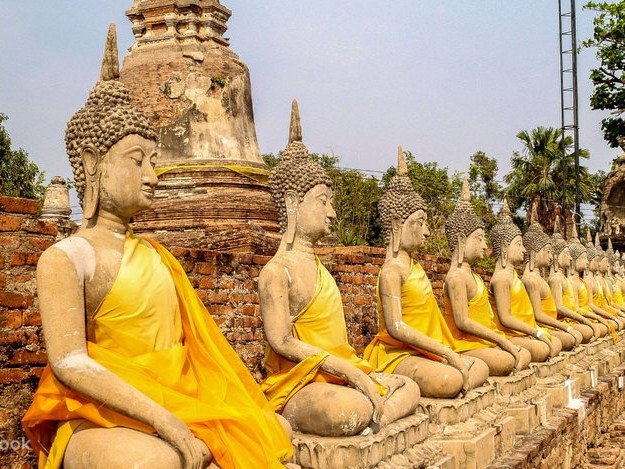
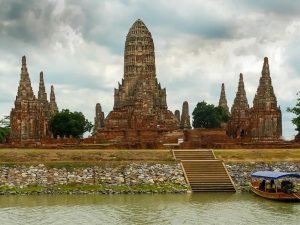
Siyam (Thailand) holds great significance in the context of Buddhism in Sri Lanka. Since ancient times, there has been a strong interconnection between the Siyam land and Sri Lankan Buddhism. Siyam’s contributions to a significant renaissance in Sri Lankan Buddhism were particularly influential during the Kandyan period. Historically, Sri Lankan rulers have also played a key role in promoting and establishing Buddhism in the Siyam region.
For the first time in my life, I had the opportunity to travel to Thailand to participate in the International Pali and Sanskrit Bhikkhu Exchange Program, organized by the Buddhist Brotherhood in Sri Lanka. This program was initiated as a visionary concept by His Holiness the Dalai Lama. I travelled to Thailand on 15 February 2025, and we stayed in Bangkok for 15 days. During that time we explored the practice and modern applications of Buddhism in Thailand. Participants in the program included Bhikkhus from Sri Lanka, Thailand, and Tibet, as well as monks from Laos and Bhutan. This note is a personal reflection on that memorable journey.
During my stay in Bangkok, I visited several major tourist attractions, including prominent Buddhist monasteries and the Royal Palace. One of the most enriching experiences of the journey was the four-day residential training program we received at Chiang Rai Host Monastery in Rai Cherntawan. The training focused on organic gardening, the interconnection between Buddhism and the environment, and how these concepts can be applied in daily life. It was a truly memorable experience. Our teacher, Ajahn V. Vajiramedhi, provided insightful guidance on how to engage in interfaith collaboration in accordance with the demands of the modern world. Ajahn’s deep understanding of the Dhamma, his practical application of modern technology and his ability to integrate both were truly admirable. His meditation centre is open to people of all faiths. It offers a welcoming space for meditation, mind training, and spiritual development regardless of one’s religious background.
We then visited a meditation center led by Ven. Ajahn Viriyo, a renowned meditation teacher in Thailand and a direct student of Ven. Man Bhuridatta Thero. We stayed there for four days and engaged in practical meditation training and scholarly debates. Our focus was on the detailed instructions on meditation found in the Pali Theravāda Tipiṭaka, as well as the specific techniques developed by Ven. Man Bhuridatta Thero. The meditation method taught at this monastery emphasizes walking and sitting meditation and begin with recollection of the Four Brahmavihārās—Metta, Karunā, Muditā and Upekkhā. After reciting the word “Buddho” three times, practitioners direct their mental focus to the forehead, chest, or belly, cultivating mindfulness through this concentrated attention. This unique technique uses the word Buddho as a mantra to deepen concentration and enhance mindfulness. This method is not found in the Visuddhimagga (Path of Purification) or other traditional meditation texts. It does not employ kasina objects but instead focuses on repeated verbal attention to Buddho or any word personally resonant to the practitioner. Though it is not part of the early canonical texts, it was later introduced to the Theravāda tradition by Ven. Man Bhuridatta Thero, and is considered a praiseworthy innovation. During our stay, we also engaged in comparative discussions and debates on Theravāda and Tibetan meditation techniques, which broadened our understanding of the diversity within Buddhist meditative practices.
 On the final night at the monastery, a Prātimokṣa (Bhikkhu Uposatha) sermon was conducted by all the senior ordained monks representing the Theravāda tradition. One monk recited from memory the entire set of 227 precepts of the Bhikkhu Prātimokṣa, a moment that deeply moved me. I was truly amazed to witness how Theravāda monks continue to preserve the Buddha’s teachings through oral tradition, even in the present day .On the following morning, the Tibetan monks performed their own Prātimokṣa chanting.
We had the opportunity to participate in several scholastic debates during our stay. The first was a discussion on the concepts of Brahmavihāra (in Pāli) and Bodhicitta (in Sanskrit), chaired by Ven. V. Vajiramedhi Thero. This was followed by a debate on the topic “Engaged Buddhism: Dhamma in the Modern World,” where special attention was given to how modern technology can be integrated into the practice and propagation of Buddhism. Another significant discussion took place at Wat Chedi Luang Varavihara. The focus was on the concepts of Anattā in Theravāda and Śūnyatā in Mahāyāna. This session offered a profound exchange between Pāli and Sanskrit Buddhist traditions and fostered deeper understanding among Theravāda and Mahāyāna monks.
I must also highlight the practical experiences we had, such as meditation and the traditional alms rounds, which brought meaningful insights into our spiritual lives. At the beginning of our journey, we went on an alms round from the monastery of Ven. Ajahn Buddhadāsa Thero, and continued the practice at Rai Cherntawan. One unforgettable moment was walking approximately 2.5 kilometers on alms round from the monastery of Ven. Luang Por Viriyang Thero. We also took part in alms rounds at Wat Phra Singh in Chiang Mai and at the Buddhadasa Indapanno Archives in Bangkok, both associated with Ajahn Buddhadāsa Thero.
I had the honour of representing Sri Lanka on this tour and was privileged to serve as a translator. Based on my observations, I would conclude that Buddhism in Thailand reflects a harmonious blend of tradition and modernity. A significant number of Thai Buddhist monks have embraced modern technology to practice and propagate the Dhamma, adapting skillfully to contemporary needs. At the same time, another portion of the monastic community remains deeply committed to the traditional way of life, sustained solely by alms rounds and guided by the Vinaya and lofty principles preserved in the Buddhist scriptures. Notably, Thailand’s forest monastery tradition which is the oldest form of monastic life in the country still continues to be upheld by a devoted group of monks by preserving the lofty qualities of Buddhism.
During this journey, I had the unique opportunity to meet not only Thai monks but also Tibetan monks, whom I encountered for the first time in my life. Among them were monks from the Gelugpa tradition, one of the major schools of Tibetan Buddhism. I carefully observed their behaviour and daily routines. From as early as 4:00 a.m., they begin chanting “Om Mani Padme Hum”, continuing this sacred mantra throughout the day as a way to maintain mindfulness and spiritual awareness. Their deep dedication to cultivating mindfulness was truly inspiring. I also witnessed philosophical debates on Śūnyatā (emptiness) conducted as part of their intellectual training. The logical and analytical methods they employed were remarkable. These debates typically began with an invocation to Mañjuśrī Bodhisattva, a revered figure in Tibetan Buddhism. The monks’ genuine compassion, humility, and deep understanding of Buddhist doctrine left a lasting impression on me. Some of them naturally became my teachers, as they were always ready to explain complex Buddhist concepts with clarity and patience.
A highlight of this experience was the chance to celebrate the Tibetan New Year (Losar) on 28 February at Wat Umong. I consider myself fortunate to have participated in this celebration, especially as someone with a strong interest in Tantrayāna Buddhism. The monks welcomed me warmly, and their cordial nature and openness deepened my appreciation and connection with them.
Overall, my first international trip was filled with meaningful memories, intensive training sessions and enriching interactions across Buddhist traditions. I was recommended for this program by Prof. Ven. Miriswatte Wimalagnana Thero, Professor of Pāli and Buddhist Studies at the University of Kelaniya and my MA mentor, to whom I am deeply grateful. I also extend my heartfelt thanks to Dr. Damenda Porage, founder of Foundation for Buddhist Brotherhood, and its secretary, Mr. Duminda, for their support. My sincere gratitude also goes to Ven. Mahayano and the Thai organizing team, who ensured our needs were met with great care and hospitality throughout the journey.
© Satipatthāna Magazine