
BUDDHIST ETHICS AND ITS IMPACTS ON MODERN TIME
A Thesis Submitted to the Examination Committee (2019) in Partial Fulfillment of the Requirements for the Degree of Master of Arts in Philosophy
Human beings wish to lead their life through the light of their knowledge regarding themselves and the world. So, it is a human’s rational nature to desire knowledge. And, Philosophy literally means ‘love of wisdom’ or ‘pursuit of knowledge’. Therefore, Philosophy is a way of satisfying this very reasonable quest for knowledge. It is a truism that Philosophy is an attempt to achieve the rational concept of reality as a whole. It enquires into the nature of the universe in which we live, the nature of the human soul and its destiny, and the nature of God or the Absolute thought, and their relation to one another. It also investigates the nature of matter, time, space, causality, evolution, life, and mind, and their relation to one another. In short, Philosophy is the art of thinking all things logically, systematically, and persistently. Philosophy is not a mere luxury, but a necessity. As an eminent English writer, Aldous Huxley puts it:
Men live in accordance with their philosophy of life, their conception of the world. This is true even of the most thoughtless. It is impossible to live without a metaphysic. The choice that is given us is not between some kind of metaphysic and no metaphysic; it is always between a good metaphysic and a bad metaphysic.
It is generally true that Philosophy is built upon wonder or doubt and speculation. Western Philosophy is guided by theoretical interest. Its foundation is the independent reflection untrammeled by authority. It is not guided by practical considerations of morality and religion. But Indian Philosophy is actuated by spiritual motives. It is a speculation on the nature of reality with a view to attaining liberation which is the Summum Bonum of human life.
Indian philosophy is the philosophical speculations of all Indian thinkers, ancient or modern, Hindus or non-Hindus, theists or atheists. According to a traditional principle of classification, adopted by most of the orthodox Hindu thinkers, the schools or systems of Indian philosophy are divided into two broad classes named orthodox (āstika) and heterodox (nāstika). The six chief philosophical systems addressed Mīmāṁsā, Vedānta, Sāṅkhya, Yoga, Nyāya, and Vaiśeṣika belong to the first group. These are regarded as orthodox (āstika), not because they believe in God, but because they accept the authority of the Vedas. Under the other group of heterodox (nāstika) systems, the chief three are the schools of the materialists like the Cārvākas, the Buddhas, and the Jainas. They are called heterodox (nāstika) because they do not believe in the authority of the Vedas.
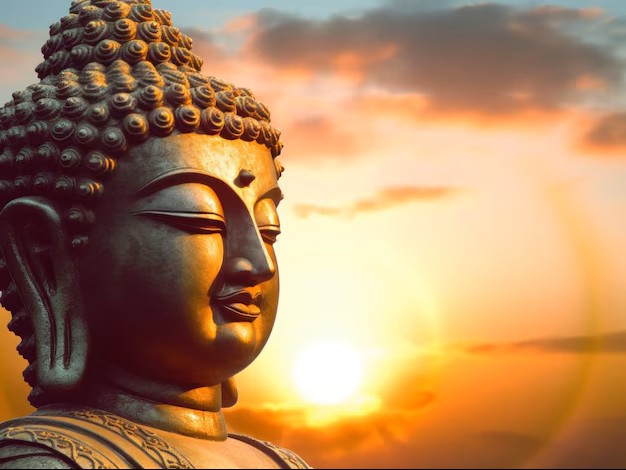
Morality and ethics can exist apart from religion, for example in humanism or utilitarianism, or ethics can be integrated into a religious system. The second thing happens with Buddhism. Buddhism flourishes through the ethical perspectives of the Buddha. Morality is woven into the fabric of Buddhist teachings and there is no major branch or school that fails to emphasize the importance of the moral life. The core of Buddhism is composed of the ethical principles and precepts as well as the values and virtues expounded by the Buddha.
According to the history of philosophy, the system of early Buddhism is one of the most original. In its fundamental ideas and essential spirit, it approximates remarkably to the advanced scientific thought of the nineteenth century. As Buddha teaches the opposite truth of what Upanisads or Vedas taught. Buddha finds that everything is impermanent (anītya). There is no permanent self (anātman). All is suffering (duḥkha). The self is an impermanent mind-body-complex (samudāya). There is no God or the Absolute as Creator of the world. It is self-existent. It is without beginning or end. It is unsustainable (nissatta) and soulless (nijjiva). There are no permanent substances. There are only impermanent qualities (dhamma) or phenomena. They are subject to the inexorable law of becoming or dependent origination (pratītyasamutpāda). They are produced by their causes and conditions. The law of causation is subservient to the moral law. It is the law of karma. It is the law of righteousness (Pali: dhamma, Sanskrit: dharma).6
So, according to Buddha, Life is full of suffering and suffering is due to craving or will-to-live (tṛṣṇā). Will-to-live is due to ignorance (avidyā). Ignorance is false knowledge of the impermanent as the permanent. It is a delusion of individuality. It is the root of the cycle of birth and death. Ignorance cannot be killed by philosophical knowledge. Buddha adopts an anti-metaphysical attitude which can be termed as moral pragmatism. His teachings aim at the total extinction of suffering and attainment of nirvāṇa here on earth. Nirvāṇa is the perfect peace and equanimity. It is perfect enlightenment (bodhi). The way to nirvāṇa is the eight-fold path (āṣṭāṅga-mārga) of right conduct (śīla), concentration (samādhi), and insight (prajñā). The delusion of individuality or egoism must be extirpated. When egoism is eradicated, will-to-live (tṛṣṇā) or craving is destroyed. The wheel of birth and death is ended and nirvāṇa is attained.