
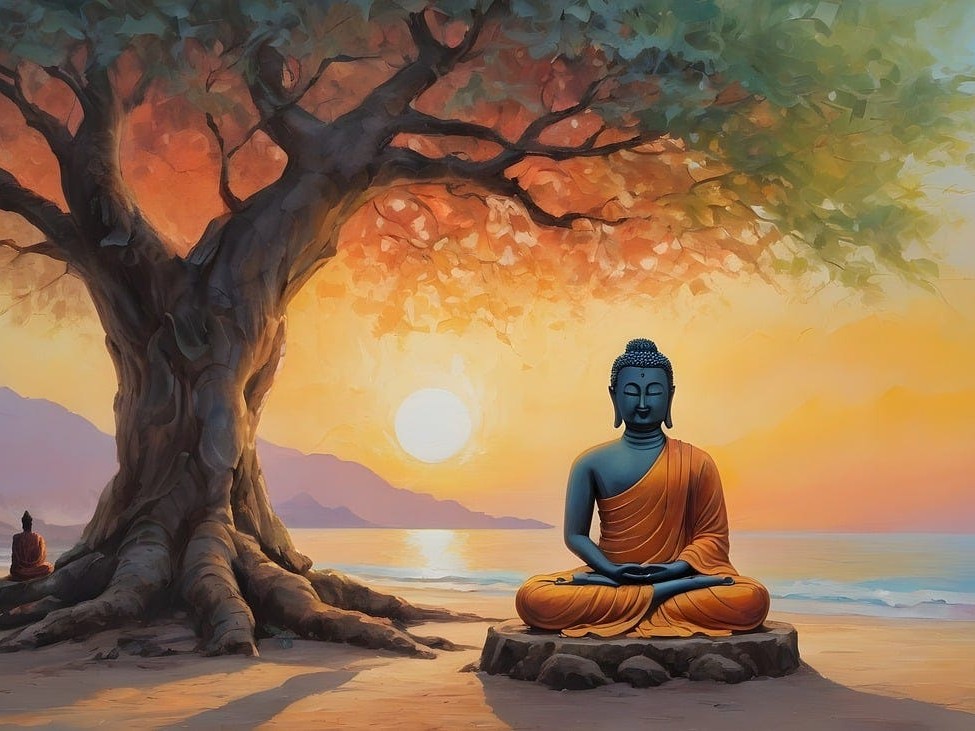
I wish to be pure but I am lazy.
To maintain purity in anything, it must be cleansed again and again. Only by repeatedly washing a soiled cloth can we truly see the stains it held; and in that way the washing also becomes easier. Likewise, we should strive to purify our mind again and again through satipatthana (foundations of mindfulness), through vipassana (insight), or, in other words, through anupassanā (contemplative observation).
Though repeated purification can lead to true purity, our mind does not like it. We do not incline to it. We want to do it all at once. People want to purify the mind in such a way that it will not become defiled again. The purity of the mind is Nibbāna. People want to purify the mind of lust (rāga), purify the mind of hatred (dōsa), purify the mind of delusion (mōha). They want complete purity. So, they pay homage to the Blessed One and pray: “By this merit, may I realize Nibbāna.” Even after listening to the Dhamma, they pray. Doing many meritorious deeds, people pray: “By this merit, may I attain Nibbāna.” Why? Because people truly do desire purity. But they are lazy.
If one were told to meditate for just ten minutes every evening, develop cittānupassanā (mindfulness of mind), investigate the mind, reflect on the day’s shortcomings who would be ready to do it? Not even one in a hundred would be willing. Why is that? People are not inclined to set aside even five minutes a day for this. They are not prepared to be that dedicated. Yet they want complete purity of mind.
So nowadays some look for various shortcuts, different methods to attain Nibbāna. They think: “This cannot be done in that way. It can be done all at once if, in the future, we meet the Maitriya Buddha. If we hear a single verse from him, we will realize Nibbana right then.” “Isn’t that how Venerable Sāriputta realized Nibbāna? How Venerable Moggallāna realized Nibbāna? How the group of five ascetics realized Nibbāna? Why can’t I? So, I, too, aspire to see the Maitriya Buddha and realize Nibbana.” Thus, while performing all kinds of meritorious deeds, they wish to meet the Maitriya Buddha. Likewise, some others say: “You cannot realize Nibbāna by meditating. There is no fruit in that. You must listen to the Dhamma to realize Nibbāna.”
Practice is needed
In this way, under the name of the Dhamma, countless wrong views are arising in Sri Lanka. There are also those who accept these false ideas. We often meet some vulnerable people who have taken them as true and become helpless because of them. It is impossible, in any situation, to clearly explain to them that it cannot be done like that. One can never make them understand how Venerable Sāriputta became a stream-enterer (sotāpanna) after hearing a single verse. He was able to become a sotāpanna because his mind had already been greatly purified, purified over many lifetimes, an uncountable number of times. A purified mind, like a clean white cloth pressed onto a pale or dyed vessel, takes on a fine sheen. That does not take much time. For this to happen, the mind must already be purified. If it has not been purified, that state cannot be attained.
Therefore, for such prayers whether to realize Nibbāna by hearing the Dhamma or by seeing the future Buddha Maitriya to bear fruit, we must understand the nature of our own minds. With minds like these, can I realize Nibbāna just by listening to the Dhamma? In this boundless round of rebirths, have we not met Buddhas before? Surely, we have met many Buddhas. Surely, we have heard ample Dhamma. Then why did we not realize Nibbāna? Because our minds were not purified to the suitable condition. It is as if we went to apply dye without first cleaning our cloth. Therefore, our undertaking has not succeeded.
 If the mind is pure, it understands immediately.
The Blessed One teaches: If someone presses a purified cloth onto a dyeing vessel, in that very instant his wish is fulfilled. Only those noble ones who have a well-trained mind can, in the presence of a Buddha, hear the Dhamma and realize Nibbāna. One can reach that state only if one is an energetic noble person who, by maintaining mindfulness again and again, restraining the defilements (kilesa), has purified the mind. For anyone outside of that, it is difficult to realize that state.
The Buddha did not teach only to Venerable Sāriputta. He did not teach only to Venerable Moggallāna. He did not teach only to the group of five ascetics. He taught King Pasenadi of Kosala; why did he not realize Nibbāna? A collection of suttas addressed to King Pasenadi is separately listed in our scripture books as the Kosala Saṁyutta. Likewise, many suttas addressed to Queen Mallikā are recorded. There are also suttas given with Devadatta as the occasion. There are suttas given with King Ajātasattu as the occasion. Who among them realized Nibbāna? None of them did. Why is that? They did not have the necessary qualification. What is the qualification? A trained mind. In a trained, purified mind, that Dhamma soaks in. With an untrained, defiled mind, there is no ability to attain that state.
Therefore, if someone is able to purify their mind again and again, that person will be able to fulfill their aspirations properly. Instead of doing it that way, people grow lazy about it, set aside the simple, gentle daily practice that can be done with ease, and try to do everything at once ending up very exhausted. We suffer. Some who suffer like that come and tell us: “Venerable Sir, I get angry a lot. Please teach me a method to reduce this anger.” “Lay devotee, in the evening offer flowers and do a little meditation.” They do that advice for a day, for two days, for a week. Then they come back complaining: “Venerable Sir, there is no result from doing this. I just can’t reduce my anger!” Why the complaints? Because the mind is not yet prepared to wisely investigate the surge of daily impulsive thoughts, yet they also want to reduce their anger.
The unseen purity of the mind.
In this way our minds have become conditioned. We are moved to clean, to purify only if others will see it. If no one sees, it doesn’t matter even if there’s a heap of trash in the corner of the house. We are prompted to clean the house, trim the branches, polish the floor, cut the cobwebs only when a wedding is near, or a merit-making ceremony is near, or a friend is coming to our home. Why act like this? Because if people coming and going see it, that’s not good. We have often seen everyone gathered and working very hard to clean the doorway of the house, saying, “Clean these things up, child.” Why do they do that? People think it won’t look good if others see it. That is considered a matter of shame. This is what is meant by cleansing out of fear of worldly blame. That too is good. That too should be done. But for a person striving to realize Nibbāna, it is not enough to do this solely out of fear of worldly blame. There must be genuine enthusiasm for it. There must be a true need for it. Without that, even if one cleans, there will be no benefit.
All the activities we do in outer life are connected to our mind. We do these from our mind’s coolness. Therefore, if a person does not feel the need to clean the house, wash the dishes they use, rinse them and keep them pure, what need will they feel to purify an unseen mind? Such a thing will never happen. If one is not inclined to rinse and keep clean the very cup from which one drinks water, that person will never purify the unseen mind. If one lacks the restraint to take the leftover bits of food from one’s plate to the trash container without scattering them outside, then what kind of meditation would such a person be doing?
What kind of purity does such a person cultivate? What kind of virtue (sīla: ethical conduct) do they keep? When will there ever be restraint (samvara: guarding of the senses) in such a person’s mind? If, upon coming to that bin, they lack the inner restraint not to defile the world because of themselves, and to purify what has been defiled because of themselves, then they will never be ready to purify something unseen.
 When people go to make offerings to the deities, they even wash the coconut with saffron water. They wash the betel leaves. They wash the fifty-rupee note. Likewise, they rub sour lime on their head and bathe. But when holding a Buddha-offering, do they do even one of these actions? Why don’t they do so? People think: the things taken for offerings to the deities are seen by the gods. The gods are alive. The Blessed Buddha is not here. How could the Buddha who attained parinibbāna see these things? That feeling has seeped deeply into people’s lineage. In this way, just as described, when we look at the surface of our mind, the underlying inner conception is this. If someone says to hold a deity-offering to avert planetary misfortune, people will, come what may, go to Kataragama and spend even a thousand or fifteen thousand rupees for it.
One deceives oneself.
But if some intelligent person were to say: to dispel your misfortune, go to the monastery and clean the lamp stands, tidy around the Bodhi tree and offer some flowers no one would come forward for this. Why does this happen? People think: the Blessed Buddha is not here today. The Buddha has passed into parinibbāna. He cannot see what we do. No matter how much we do, he cannot get our work done. The gods see all this. Because they see, we think “the deities will do everything for us.”
When going to clean a devālaya (shrine), does anyone ever sweep leaves into a corner? Never. But what do people do when they sweep a Buddha-hall? They try to push the leaves under the flower stand. If not, they try to pile them in a corner. They try to shove them into a place that’s cracked and broken. They cannot bring themselves to truly remove the leaves and take them to the trash place. Looking around, they try to toss them into the field beyond the wall. But at the deities’ shrines they never do such things. Why? In the monastery, they think the Buddha does not see these things. Only if the monks see will there be a problem. They look around, thinking the monks might see.
Why are people this hypocritical? Why are people this crooked? Such a person will never see Nibbāna.
One should be honest
How did the Blessed One teach the path of practice to be followed for seeing Nibbāna in the Karanīya Metta Sutta? In the second and third points, “sakkho ujū ca suhujū ca,” what did the Buddha teach? One should be straight; one should be well and thoroughly straight. It doesn’t matter if the back is bent. Even if the spine is hunched. But the mind must be made straight; it should be made well and thoroughly straight. Thoughts should be straight. Wisdom should be straight. Understanding should be straight. Otherwise, that person will never see Nibbāna. That person becomes crooked. That person, defiled by the defilements (kilesa), becomes crooked through impurity. Straightness is lost. Therefore, if we truly conduct a Buddha offering, we should display purity even more than for the gods why for the Blessed One? Is it because the Buddha is “deva among devas”? No. Is it because he is “brahma among brahmas”? No. Is it because he is our Teacher? Not for any of these reasons. It is because the Blessed One valued the purity of our own mind.
Be purified by wisdom
What we call the Buddha is the supreme one who sees all. For him there is no difference between “inside” and “outside.” The Blessed One sees many things that the gods do not see. Whom do we mean when we say “the Buddha”? We say that Prince Siddhārtha attained Perfect Awakening (sammā-sambuddhatā) under the Bodhi tree on the full moon day of Vesak. Was it Prince Siddhartha’s body that attained Buddhahood? No. It was the mind that attained it. What did the Blessed One accomplish in attaining Buddhahood? He reached the far shore of understanding—of wisdom (paññā). Where did wisdom arise? It arose in the mind. If there had been greed (lōbha), hatred (dōsa), or delusion (mōha), all these are dispelled with the arising of wisdom. How is the mind purified? It is through the arising of wisdom that the mind is fully purified.
The Blessed One purified the mind and declared the Dhamma after the first jhāna; he purified the mind and declared it after the second jhāna; he purified the mind and declared it after the third jhāna; and he purified the mind and declared it after the fourth jhāna. Likewise, it was within the continuum purified by various advanced knowledge-powers such as the recollection of past lives (pubbenivāsānussati) that the great light of wisdom (mahā–paññā) arose. Where was this? It arose in the mind in the heart-mind (citta). If there is no purity, will it arise? No. Therefore we should understand: where there is no purity, there is never the Buddha. “Buddhahood, that awakening arises only within purity”.
One sees the Dhamma with a purified mind.
If we prepare a place for the Blessed One to abide, tidy up and make it clean and if we offer flowers to the Blessed One in the Buddha shrine, then for the Blessed One to truly dwell there, there must be fine purity. That purity is not only in the flowers, not only in the courtyard, not only in the seat in the shrine. What do we purify all of that for? To purify our own mind. So, with every grain of sand we spread, every path we sweep, every branch we trim what is this effort for at every moment? To see Nibbāna. What is Nibbāna? The arising of supramundane wisdom (lokuttara paññā). Where does wisdom arise? In the purified mind. Then this bodhi-terrace I cleanse is to gain the power to purify my mind. Through that power, wisdom arises. By that, one sees the world. To see the world means to see the Dhamma.
The Blessed One taught: “Yo dhammaṁ passati, so maṁ passati” whoever sees the Dhamma sees me. Then, is it possible to see the Blessed One within impurity? Never. The Blessed One is not there.
People today cannot see the Blessed One through any act of offering or worship. Why? Not because he has attained parinibbāna, but because they do not see the Dhamma through those acts. For the wisdom (paññā) needed to see the Dhamma to arise, there must be purity (parisuddhi).
If someone, without fully cleaning the offering table, cleans only the spot where they will place their own flowers and thinks, “Let someone else clean the rest. I’m only offering flowers here, so I’ll clean just this bit,” what has happened to that person’s mind? Right there the mind has become impure. In an impure mind there is no wisdom. Lacking wisdom, that person cannot understand that the entire flower seat should be purified by oneself.
If one trims the bodhi leaves and throws them over the wall onto the other side, then the people there cannot cultivate their fields. Why can’t they understand this? Because through laziness indolence (kusīta-bhāva) the mind has become impure. Since wisdom has not arisen in the impure mind, that person does not realize that this is wrong. The Blessed One is not there.
Seeing the Buddha
Though more than two thousand five hundred years have passed since the Blessed One’s parinibbāna, the Tathāgata can be brought forth into our mind at every moment but not as a material form. When true wisdom (paññā) arises within a being’s mind, the Blessed One is there. If someone reaches the far shore of that wisdom, that is Buddhahood.
Therefore, the Blessed One taught three occasions for seeing Nibbāna realizing Buddhahood: sammā-sambuddhatva (Perfect Buddhahood), paccekabuddhatva (Solitary Buddhahood), and sāvaka-buddhatva (disciples’ awakening). By what are Nibbāna and thus “the world” seen in each case by a sammā-sambuddha, by a paccekabuddha, and by a sāvaka? By wisdom, that is, direct understanding (paññā, avabodha). That wisdom arises in a purified mind.
So, the Blessed One abides the Buddha dwells the state of Buddhahood exists only in a purified mind. If the mind is defiled, there is no Buddhahood there; no wisdom; no understanding. One who does not remove the defilements of the mind and purify it will never see Nibbāna.
Translated by
Dr Shermila Milroy
© Satipatthāna magazine