

‘namo tassa bhagavato arahato sammā sambuddhassa’…!
Those endowed with faith and wisdom, and who are virtuous. The principal meaning in this entire discourse is satipaṭṭhāna (the establishment of mindfulness). Indeed, when the word satipaṭṭhāna is mentioned, it is a term that Sinhala Buddhists receive with great reverence. Even if only a few verses of the Satipaṭṭhāna Sutta are read, it is considered highly beneficial, and that is the intended meaning here. We do not merely recite it; we aspire to go beyond that and apply it practically in our lives-whether seated on a meditation seat, walking, or in our daily activities-to the fullest extent possible. What we now hope to achieve is the establishment of mindfulness within ourselves.
So, we need to understand or ask, why is it necessary to become so secluded, so rooted, so detached, so silent, so disciplined, and to accept the teachings from others in this way? What is the need for us to strive so much for mindfulness? The answer is that we are lacking mindfulness in our daily lives. We have become habitual, living with a sense of dissatisfaction.
Therefore, when introducing mindfulness, we often describe it in a simple way—by cleaning and preparing ourselves. This is why the Blessed One, in the Satipatthāna Sūtta, first talks about a setting that is secluded, rooted, and empty, making special mention of the environment. The meditation hall is referred to as the empty space. The forest is referred to as the wilderness. The root of the tree refers to the base of the tree.
There are two aspects to this: The practice is to be performed in a secluded space, a rooted and empty environment. After establishing this, then, in accordance with the Four Postures, one should proceed with the practice in a certain way. This is specifically outlined for the practitioner by the Blessed One in the Satipatthāna Sūtra.
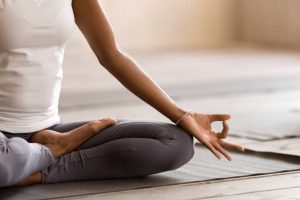
Therefore, it is explained:
‘Pallankaṁ ābhujitvā’ – Sitting cross-legged and stabilizing the posture.
“Ujjankāyaṁ paṇidhāya” – Keeping the body upright.
‘Parimuṭṭhaṁ satiṁ upaṭṭapetvā’– Maintaining mindfulness ahead of everything.
Here, it is important to focus on these details. To rephrase it differently, after establishing the basic environment—being in a secluded forest, sitting firmly with a straight back, and maintaining mindfulness ahead of all things—these are the essential elements that need to be highlighted in practice.
What does it mean? Generally, in traditional interpretations, the term is explained as holding the tongue in front of the upper palate, or placing it on the upper teeth, or resting it lightly on the roof of the mouth. Therefore, the term ‘upārimukha’ or ‘parimukha’ is understood to mean the mouth or the upper part of the head. However, establishing mindfulness (sati) does not necessarily require the tongue to be positioned in the upper palate. It can also be placed in the lower abdomen during the practice of concentration (samādhi). Thus, the interpretation should be that mindfulness is established in the present moment, regardless of the specific location of the tongue.
Alternatively, in the development of the faculties of faith (saddhā), energy (vīriya), mindfulness (sati), concentration (samādhi), and wisdom (paññā), we do not necessarily place them in the front. Rather, we aim to establish mindfulness in the present moment. Therefore, the term “satipaṭṭhāna” is used to denote the establishment of mindfulness. Consequently, even if there are various obstacles or disturbances during our practice, if we maintain mindfulness, we can consider our practice successful. Without mindfulness, we may become distracted by external phenomena, leading to confusion and hindrances.
Therefore, it is important to understand that the establishment of mindfulness is not merely a promise to attain concentration but a commitment to maintain mindfulness in the present moment. This is akin to the concept of ‘apramāda’ (diligence) in the teachings of the Buddha. The primary difference between mindfulness and diligence lies in the focus, mindfulness directs attention inward, while diligence involves outward effort.
Thus, when we sit in meditation, we should focus our attention on the present moment, saying to ourselves, “I am here, now.” This is the essence of mindfulness. If we cannot maintain our attention in the present moment, we may be considered unfit for meditation practice. Conversely, if we can maintain our attention in the present moment, we are considered suitable for meditation.
After establishing mindfulness, we proceed to further practices such as concentration, unification of mind, and purification. These are the stages of mental development.
Therefore, the first step is to maintain mindfulness in the present moment. To do this effectively, we can follow the guidance of experienced teachers. For instance, one teacher advises checking our posture by gently closing our eyes, bringing our attention inward, and ensuring that we are sitting upright and balanced. We should also relax our body and mind, allowing a sense of lightness and equanimity to arise. This state of lightness is not mere amusement but a sign of proper mindfulness.
It is important to understand that achieving this state requires consistent practice. At times, we may not experience lightness, but by maintaining our focus on the present moment, we develop deeper mindfulness. This practice is known as ‘kāyānupassanā’ (contemplation of the body).
As one proceeds along the path of ‘kāyānupassanā’ — contemplation of the body — it can be refined greatly depending on each individual’s supporting conditions and mental faculties. Therefore, the very first effort a beginner should make is to sit properly in the cross-legged ‘paryaṅka’ posture. Even if it takes a few minutes to do so, one should not consider that a loss.
Since we place the image of the Blessed One before us, we can see how supremely serene and balanced the Omniscient One appears. One can observe whether one’s own mind is directed toward the body — whether one is grounded and in balance. Indeed, the most excellent depiction in the world is the meditative statue of the Buddha in Mahāmevnāwa. It appears as though the Blessed One Himself is engaged in meditation. If one can approach that same state, it marks an auspicious entry into practice.
However, as one continues in this manner, hindrances do arise. When sounds are heard, the mind runs toward them. When sensations arise, the mind reacts to them. When thoughts arise, the mind chases after them. These cannot be entirely avoided. They are incidental disturbances that arise when the conditions of the surrounding environment come together. There is no place in the world entirely free of such influences; wherever one goes, they will be present in some measure.
Therefore, when such disturbances occur, one should not become entangled with them. Even if the mind becomes unsettled, once the disturbance passes, what should be done is to return again and establish the mind in the awareness of: “Now, I am here.” That is the practice.
At this stage, one is simply instructed to sit and observe for a few minutes. Without directing the mind, without initiating volitional thoughts, without forming aspirations — in short, without any intentional mental engagement toward the body — one simply allows the body to settle entirely. With volition suspended, observe what becomes apparent.
Once again, let it be emphasized: do not form any intention. Do not activate mental volition. Let the body settle as much as possible into stillness. Having done so, simply remain. With the eyes closed, observe, what is seen now?
At times, what occurs is that there is some indication of the continuity of life—what is called ‘prāṇayāma’ in Sanskrit. In the Magadhi language used during the time of the Buddha the omniscient one, it is referred to as ‘Ānāpāna’, meaning the inhalation and exhalation of breath. This signifies that without any intentional effort, the body, life, and consciousness continue to function in their minimal capacity, whether we are aware of it or not.
To reach this state, the meditator practices mindfulness of the body. When one is established in this practice, one becomes aware of the subtle sensations of the breath. If this awareness is not present, one may establish a support, a condition, or an object of focus. If none of these are available, one may use the posture of the body as a support. This is not a matter of regret; if the awareness of the body is present, it is an additional sign. If the awareness of the body is not present, that too is acceptable. In such cases, one maintains awareness of the body.
Sometimes, without causing disturbance, one may notice the arising of thoughts or doubts. If such thoughts arise, one directs attention to the breath. At this point, it is emphasized that one should not attempt to make the breath deliberate or forceful. The intention is not to manipulate the breath but to observe the natural, spontaneous flow of the breath without any intentional effort.
As stated in the Ānāpānasati book, “Do not make the breath prominent with effort.” The breath should occur naturally, without any volition, without holding the body, without closing the eyes, and without controlling the breath. Observe the naturally occurring breath waves without any volition.
At this point, it becomes evident that we cannot intentionally control the breath without conscious effort. Many individuals, upon attempting to observe the breath in this manner, begin to exert effort, leading to a significant challenge. When one attempts to observe the breath, it may become forced; do not be concerned. What is essential to remember is to observe the breath as it naturally occurs, without effort. If, at this moment, the breath is becoming forced, that is not my intention; there is no need to worry. Simply observe.
If, at that moment, you find yourself face-to-face with the breath, there is no requirement to do so; however, if you do, it may become possible to observe. This breath process occurs naturally in the upper body. At that point, if the body is upright, the mind should focus solely on the upper body, allowing the lower body to be forgotten.
Thus, this represents an advancement: observing the breath occurring naturally in the upper body, while perceiving it as a natural process, and allowing the lower body to remain relaxed. Now, another step forward is as follows: while observing the breath wave, keep the upper body straight. Otherwise, there is a possibility of experiencing discomfort or other difficulties. Therefore, to prevent the breath wave from becoming forced or strained, maintain the upper body straight.
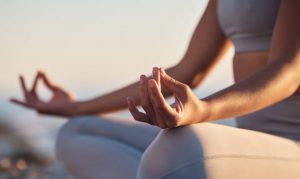
Consequently, whether seated on a chair or on the floor, the practitioner should ensure that the upper body remains upright. Otherwise, there is a risk of encountering certain difficulties after some time.
Let us consider that, while observing the breath, we become aware of the breath’s nature. A deeper term used here is ‘kāya saṅkhāra’ (bodily formation). The minimal requirement for the body’s continuation is the breath. When focusing on the breath, if one is experienced in meditation or possesses spiritual faculties, it becomes possible to take another step forward. If not, there is no hindrance. However, if one does possess such faculties, it is a highest blessing, indicating that one can derive benefit from this practice in this life.
What is this highest blessing? While observing the upper body, one becomes aware of where the breath wave is most prominent. One observes where the breath wave is most pronounced and where it is most subtle. At this stage, any point from the nostrils to the abdomen can become prominent. This is how the various meditation techniques are taught. Meditation methods vary greatly. At this point, what is important to understand is that one should never seek a specific point. Allow the breath to naturally settle, and observe where it becomes most apparent to you.
If one becomes distracted by the breath, one cannot observe the breath wave. If one moves while walking, one cannot observe the breath. If one joins in dancing as the procession goes by, one cannot observe the procession. To observe the procession, one must step aside, sit down, and watch as the procession passes.
Therefore, it is essential to observe the area where the breath sensation is most prominent. If this is not done, it becomes challenging for approximately 30% to 40% of yogis to comprehend the practice. This is neither their fault nor a lack of interest; it is simply the nature of the practice. Therefore, do not let this become an obstacle. If you have the sensation of the breath, you have it. If someone experiences the sensation of the breath, two things can be observed: one is that during the moments of confidence, doubt does not arise; the other is that during moments of doubt, confidence is absent. These two should be distinguished. When observing, the mind should be thoroughly clear. If, by observing, you can distinguish between confidence and doubt, you will notice that confidence has unique characteristics absent in doubt, and doubt has unique characteristics absent in confidence. If you become aware of this, you can proceed in the practice of ‘Ānāpānasati’ as a beginner, reaching a higher level. This is confidence. This is not doubt; these are the unique characteristics of confidence. These are called natural characteristics, self-characteristics, tendencies, mental characteristics, personal characteristics, and many others. It is very important to recognize confidence as confidence during the practice and to see how it differs from doubt. During moments of doubt, distinguish it from confidence and observe its unique characteristics.
So, this is truly the guidance for someone practicing ‘Ānāpānasati’. These instructions are indeed extensive. There is no need to regret if you have not received them before. Generally, if you can maintain the sensation of the breath, these things can gradually develop. However, do not feel remorse if they have not developed yet.
(In the next section, let us explore another aspect of mindfulness.)
© Satipatthāna Magazine