
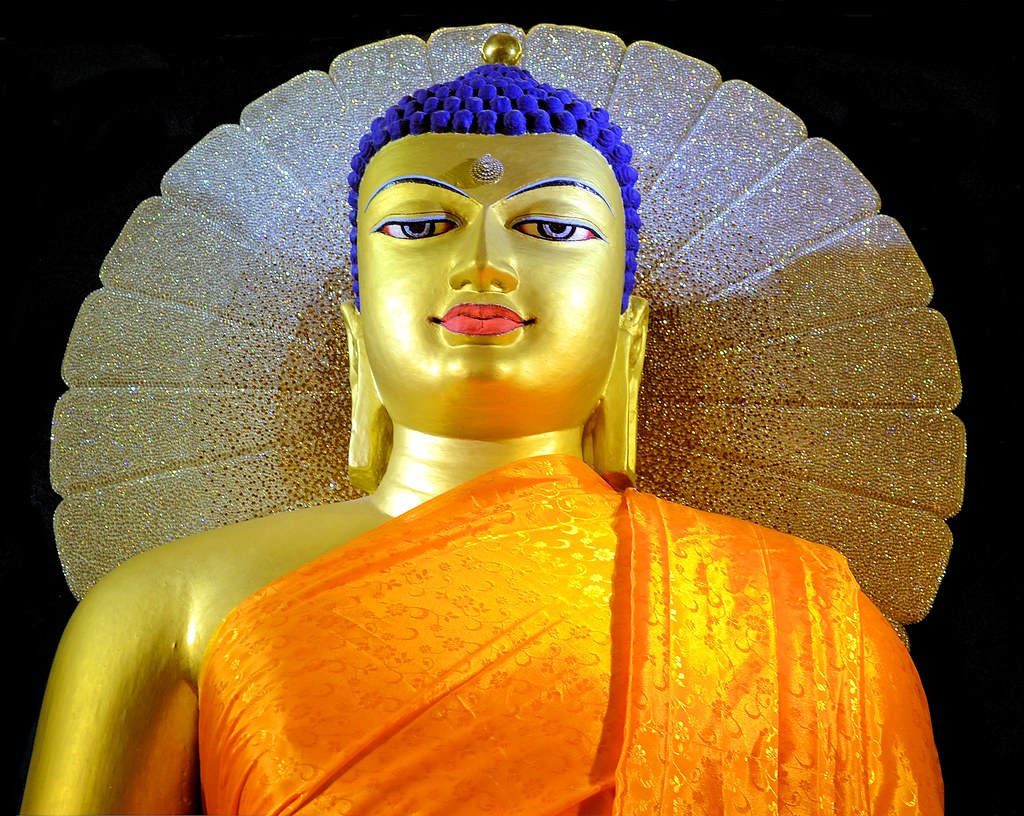
The Buddha’s Birth, Enlightenment and the Great Demise Took Place in India
By Snr. Prof. Anura Manatunga
The Buddha was a historically significant figure who lived in the Indian subcontinent around 500 BCE. It is well established that the ancient region known as Jambu Droni, or Dambadiva, refers unmistakably to the Indian peninsula. Claims suggesting that Dambadiva was located in Sri Lanka and that the Buddha was born there are entirely unfounded and devoid of logical or historical basis. Such assertions often stem not only from a lack of understanding of history and archaeology but also from deliberate attempts to distort the authentic origins of Buddhism and undermine its historical foundation. Fortunately, no credible historian or archaeologist, whether local or international, supports the notion that the Buddha was born in Sri Lanka. The consensus remains clear- the Buddha lived and taught within the region known as the Solos Maha Janapada in the Indian subcontinent. The land surrounding the sacred Ganga River, nestled south of the Himalayan range, was sanctified by the presence and footsteps of the Enlightened One.
Many ancient sites associated with the life of the Buddha have been identified within this region. Among them, four sacred locations hold particular significance such as Lumbini, the birthplace of Prince Siddhartha; Bodh Gaya, where he attained enlightenment and became the Buddha; the city of Sarnath (near ancient Sravasthi), where he delivered his first discourse; and Kusinara, where his Parinirvana (great passing away) took place. The historical facts related to these revered sites are explored in detail in this article.
 Lumbini
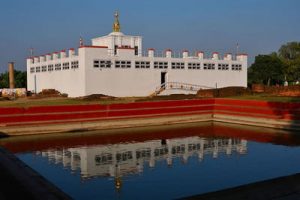
Buddhists recognize that Prince Siddhartha was born in Lumbini. All ancient texts describing the Buddha’s birth consistently identify Lumbini as his birthplace. According to the Jataka Atthakatha Vannana, Lumbini is located between the cities of Kapilavastu and Devadaha. The Pabbajja Sutta also affirms that this place belonged to the Sakya Janapada and was situated in the Himalayan region.
According to scholars, the Nalaka Sutta in the Sutta Pitaka inaccurately states that Prince Siddhartha was born in Shakyagrama within the Lumbini Janapada. However, other ancient texts provide more consistent accounts. The Lalitavistara refers to the birthplace as the Lumbini forest, while the Mahāvastu describes it as the Lumbini garden. The Jātaka Aṭṭhakathā Vaṇṇanā identifies the location specifically as Lumbini Mangala Sālavana, meaning the auspicious Lumbini grove. The term “Lumbini” itself signifies a place abundant with trees. Both the Lalitavistara and Buddhacharita offer detailed descriptions of Lumbini as a lush, vibrant setting filled with trees, flowers, and birds such as swans.
All Buddhists are aware that Queen Mahā Māyā gave birth to Prince Siddhartha beneath a Sāla tree in the sacred grove of Lumbini. During his lifetime, the Buddha himself visited Lumbini on his way to Devadaha and delivered the Devadaha Sutta there, further affirming its significance.
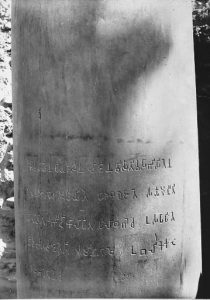
In the 20th year of his reign, Emperor Ashoka undertook a pilgrimage to Lumbini to pay homage to the Buddha’s birthplace. To commemorate the visit, he erected a stone pillar inscribed with a declaration that this was indeed the place where the Buddha was born. This inscription later played a crucial role in confirming the exact location of Lumbini. Ashoka’s pilgrimage took place 316 years after the birth of Prince Siddhartha.
Lumbini has long been a revered pilgrimage site for Buddhists and is also mentioned by the renowned Chinese pilgrims Fa-Hien and Xuanzang (Heun Tsang). Around 400 years after the Buddha’s birth, in the 5th century CE, Fa-Hien visited Lumbini en route to Kapilavastu. He recorded that Lumbini lay 50 li east of Kapilavastu. Later, in 636 CE, Xuanzang visited Kapilavastu and gathered accounts of Lumbini. In his detailed notes, he described the remnants of Ashoka’s pillar, which featured a horse-shaped capital and had been toppled by a dragon. He also mentioned a stupa built by Emperor Ashoka and a small river flowing southeast of Lumbini. These descriptions proved invaluable in later efforts to accurately identify the historical site of the Buddha’s birth.
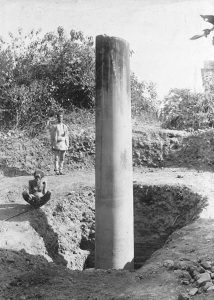 In 1894, in the Therai jungle of Nepal at a place called Rumindai, a group of people cutting firewood discovered a fallen stone pillar, partially buried under soil and debris. Upon excavation, they uncovered a stone inscription on the column. German archaeologist Alois Anton Fuhrer, who had a keen interest in archaeological findings, studied the inscription and identified the column as one erected by Emperor Ashoka to mark the birthplace of Prince Siddhartha. It was revealed that Rumindai was the ancient site of Lumbini, with linguistic studies confirming that the name “Rumindai” had evolved from “Lumbini.”
 Fuhrer continued excavations at the site and unearthed the ruins of a temple believed to have been built by Emperor Ashoka. Among the findings was a stone statue of Queen Maha Maya grasping a tree branch. At the center of the excavated ruins stood the Maya Devi Temple. Later, Indian and Nepalese archaeological officials carried out further excavations near the temple, discovering additional ancient structures. The Ashoka Pillar was subsequently reinstalled.
In 1999, Lumbini was designated a UNESCO World Heritage Site. Between 2012 and 2013, Professor Robin Cunningham led excavations at the Maya Devi Vihara, uncovering what is believed to be the oldest known temple at the site, made of clay and located beneath the brick structure of the current Maya Devi Temple. A portion of what is believed to be a sacred Sala tree was also found during these excavations.
Bodh Gaya
Bodh Gaya in India is universally recognized as the place where Prince Siddhartha attained enlightenment and became the Buddha. It is situated about 15 kilometers south of Gaya town in the state of Bihar. Locally, the area is simply known as Bodh Gaya. The Lilanjan River which flows to the east of the site is identified with the ancient river Neranjana mentioned in Buddhist texts.
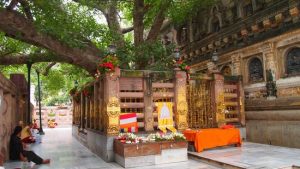 In ancient scriptures, Bodh Gaya has been referred to by various names, including Bodhi Mandala, Gaya Shirsha, Gayawa, and Bodhi Vrukshaya. The name Bodh Gaya is believed to have come into use around the first century CE, as referenced in stone inscriptions by Amaradeva.
An important mention of the site appears in the 8th stone edict of Emperor Ashoka, which records his visit to the place where Prince Siddhartha attained Buddhahood. During his reign, Ashoka built a structure known as the Bodhi Ghara, which enclosed the sacred Bodhi Tree and the Vajrasana (Diamond Throne). Carvings from Bharhut also depict scenes from this sacred enclosure. Chinese pilgrim Xuanzang (Heung Sang) also documented this Bodhi Ghara in his travel writings. Today, neither the original Bodhi Ghara nor the tree from Ashoka’s time survives, as the Mahabodhi Viharaya was later built on the same site.
According to legend, one of Ashoka’s concubines, jealous of the Emperor’s devotion to the Bodhi Tree, believing he loved it more than her (Tishyaraksha) ordered a minister to kill the tree using poisonous thorns. Though the tree grew back, it was destroyed again by Pushyamitra Shunga. It regrew once more, only to be destroyed later by King Shashanka.
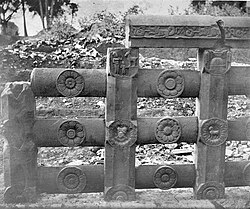 One of the oldest surviving elements at the site is the intricately carved stone lattice surrounding the Mahabodhi Viharaya. This may have originally been part of the fence built by Emperor Ashoka around the Bodhi Ghara. Ancient Brahmi inscriptions and carvings are still visible on this lattice.
In 1879, British archaeologist Alexander Cunningham rediscovered Bodh Gaya, guided by the records of Xuanzang. At that time, the site had come under the control of a Hindu Mahant, who claimed it as private property. Anagarika Dharmapala, launched a campaign to reclaim the site for Buddhists.
In 2002, the Mahabodhi Temple Complex at Bodh Gaya was designated a UNESCO World Heritage Site.
 The City of Shravasthi
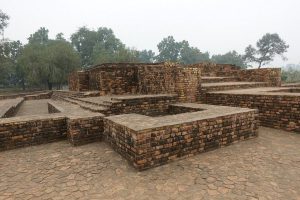
The place where the Buddha delivered his first sermon, known in ancient texts as Isipathana and Migadaya is present-day Sarnath in Uttar Pradesh. Historically referred to as Isipathanarama in Shravasti, Sarnath is located approximately 10 kilometers north of Varanasi, which was formerly known as Baranasi. This location lies near the confluence of the Varuna River and the Ganges. The identification of Sarnath has been greatly supported by the travel accounts of Chinese pilgrims Fa Hien and Xuanzang (Heun Tsang).
Shravasti holds significance as the site where the Buddha delivered the Dhammacakkappavattana Sutta, his first sermon, and where the first group of Bhikkhus of the Buddha Sasana was established. The Buddha spent considerable time here, delivering numerous sermons. Archaeological excavations in Shravasti unearthed the Gandhakuti, the dwelling where the Buddha stayed.
Among the notable structures at Sarnath is the Dhamek Stupa, previously known as the Dhammika Stupa, and the Ashokan pillar, erected by Emperor Ashoka. The pillar is crowned with the famous four-lion capital, which inspired India’s national emblem. The Dharmachakra, central to the Indian flag, also derives from this symbol.
Excavations at the Sarnath site began in 1835 under Alexander Cunningham. Later, significant contributions to the site’s excavation and preservation were made by Dayaram Sahni and John Marshall. Since 1998, the Government of India has been advocating for Sarnath to be designated as a UNESCO World Heritage Site, though this recognition has not yet been granted.
 Kusinara
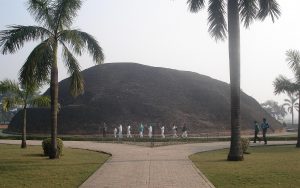
Kushinagar, anciently known as Kusinara, is the sacred site where the Buddha attained Mahaparinirvana (the great demise). It is identified with present-day Kasia village in India, located about 53 kilometers east of Gorakhpur. During the time of the Buddha’s passing, Kusinara was a small village with only a few clay houses. The Buddha arrived at the Sala grove near Kusinara to enter final Nirvana. Interestingly, Kusinara had once been known as Kushavati, a prosperous city long before the Buddha’s time. It served as the capital of the Malla kings and was part of the legendary kingdom of Emperor Maha Sudassana. The Buddha had visited Kusinara several times during his lifetime to deliver sermons before his final journey there.
A week after the great demise of the Buddha, his sacred body was brought into the city through the northern gate and carried out through the eastern gate for cremation. The cremation took place at a site known as Makutabandhana, a place historically used for the coronation ceremonies of the Malla kings.
After the cremation, a dispute arose among the various clans and kingdoms over the possession of the Buddha’s sacred relics. To resolve the conflict, a wise mediator named Drona the Brahmana intervened. He peacefully settled the issue by dividing the relics into eight equal parts and distributing them among eight claimants:
- Ajatashatru of Magadha
- The Lichchavis of Vesali
- The Sakyas of Kapilavastu
- The Bullis of Allakappa
- The Kolis of Ramagrama
- A Brahmana of Vetadeepa
- The Mallas of Pava
- The Mallas of Kusinara
Later, the Moriyas of Pipphalivana, who arrived after the distribution, received only the charcoal from the cremation pyre. As a token of his role, Drona Brahmana retained the urn that was used to divide the sacred relics.
The Mallas of Kusinara erected a stupa to enshrine the relics they received after the Buddha’s cremation. It is widely believed that the Ramabhar Stupa marks this sacred spot. The Chinese pilgrim Xuanzang (Heung Tsang) noted in his travel records that the area contained many Sangharamas (monasteries) and stupas, affirming its religious significance. He also recorded that Kusinara was located 19 yojanas from Vesali, providing a geographical reference that aligns with historical accounts. In 1861–62, Alexander Cunningham excavated the Ramabhar Stupa and confirmed that Kusinara was indeed the site where the Buddha attained Mahaparinirvana. In 1876, Archaeologist Archibald Carlleyle uncovered a reclining Buddha statue, measuring 6.1 meters, beneath the Parinirvana Stupa.
Between 1904 and 1907, J.P. Vogel (likely what you meant by “J.P. Pugal”) conducted several excavations that further validated Kusinara as the site of the Buddha’s Mahaparinirvana.
It is unfortunate that some continue to spread the myth that the Buddha’s birth, Enlightenment, and Mahaparinirvana occurred outside of India, despite the clear and well-documented evidence provided by historians and archaeologists confirming these events took place within India.
© Satipattāna Magazine