
By Dr Damenda Porage
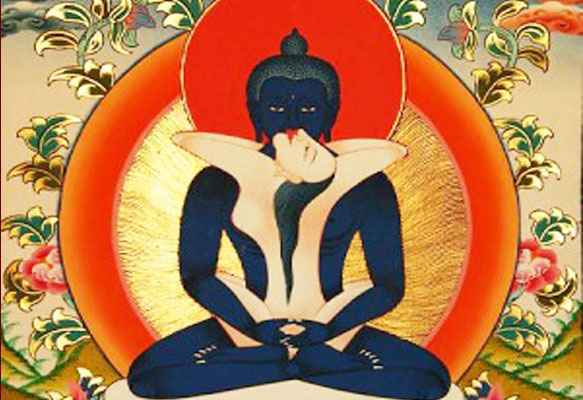
This non-duality is further illuminated by the central polarity of Wisdom (Prajna or Shunyata) and Compassion (Karuna or Upaya). Wisdom, understood as voidness, represents the indestructible, diamond-like nature that transcends all duality. Compassion, on the other hand, is the dynamic, active means for benefiting sentient beings. Enlightenment arises when these seemingly opposite principles are experientially understood as one, often symbolized in Vajrayana art by the union of passive female deities (wisdom) with dynamic male deities (compassion).
In the vast tapestry of Buddhist traditions, Vajrayana Buddhism shines as a distinct and potent path, often referred to as the “Diamond Vehicle” due to the unshakeable, diamond-like nature of the truth it seeks to attain. Originating in northern India around the 5th century CE and firmly establishing itself in Tibet by the 7th and 8th centuries, Vajrayana, widely known as Tibetan Buddhism, represents a profound and accelerated approach to spiritual awakening. Unlike some other Buddhist schools that emphasize gradual accumulation of merit over countless lifetimes, Vajrayana posits that enlightenment can be achieved in this very lifetime, making it a uniquely dynamic and direct path.
At its heart, Vajrayana is a form of Esoteric Buddhism, meaning its teachings are often conveyed implicitly or “secretly,” not to be withheld from the worthy, but because their profound truths are best understood through direct, personal experience and the guidance of a qualified master. This emphasis on experiential realization over purely intellectual understanding is a hallmark of its practices.
The Three Mysteries: Body, Speech, and Mind in Unison
Central to Vajrayana’s transformative practices are what are known as the “three mysteries” (or “three intimacies”) of body, speech, and mind. These are not mere symbolic acts but are considered direct means for the practitioner to engage with ultimate reality and achieve identity with the cosmic Mahāvairochana Buddha.
Mudras (Body): These are specific symbolic hand gestures and postures. By forming mudras, practitioners align their physical being with enlightened qualities, embodying the principles they seek to realize.
Mantras (Speech): Sacred syllables, words, or phrases chanted aloud or silently. Mantras are believed to purify and protect the mind from illusion, bringing powerful results and clearing mental obscurations.
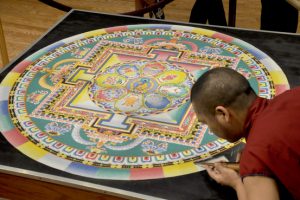
Mandalas (Mind): These are intricate cosmic diagrams that serve as focal points for visualization and meditation. Mandalas represent the cosmic order and the enlightened mind, guiding the practitioner’s concentration and facilitating profound insights.
Through the synchronized practice of these three mysteries, the practitioner’s physical actions, speech, and thoughts become direct manifestations of the cosmic Buddha, transforming ritual into a deeply embodied engagement with ultimate reality.
Deity Yoga: Becoming the Awakened Form
One of the most powerful and distinctive practices in Vajrayana is Deity Yoga. This involves the visualization and identification with specific deities, who are not seen as external gods but as symbolic representations of enlightened qualities inherent within oneself. With the aid of mudras, mantras, and icons portrayed within a mandala, practitioners visualize these deities and then take on their identity.
The purpose of this transformative identification is to realize that each divinity, in essence, is shunyata (“voidness”)—the ultimate emptiness of inherent existence. The culmination of this process, known as vajrasattva yoga, is believed to bestow upon the initiate a “diamond-like body beyond all duality,” signifying an unshakeable realization of their true nature. This practice allows the practitioner to directly experience their inherent Buddha-nature, rather than merely contemplating it.
Philosophical Foundations: Non-Duality and Embodied Wisdom
Vajrayana builds upon the Mahayana understanding that nirvana (liberation) and samsara (the cycle of suffering) are fundamentally non-dual. This means that liberation is not achieved by escaping the world, but by transforming one’s perception and engagement within it. Passions and aversions, often seen as obstacles, are embraced as skillful means to awakening, recognizing their inherent potential for liberation.
A radical aspect of Vajrayana philosophy is its assertion that the body itself is a vehicle for enlightenment. Since all phenomena are ultimately of one nature (the void), physical and mental processes can be directly utilized for spiritual realization. Texts like the Kalachakra-tantra even teach that in this age, enlightenment must be achieved through the body, which is understood to contain the entire cosmos. This transforms the spiritual journey into one of profound, embodied engagement with the world.
The Indispensable Guru and Progressive Stages
The path of Vajrayana is critically dependent on the guidance of a qualified master, or Guru/Lama. The master initiates the student into esoteric practices, guiding them through complex methods and ensuring proper understanding and application. The texts that guide these practices, known as tantras, are written in highly figurative and symbolic language, often kept secret because literal interpretations could lead to misinterpretations or even harmful practices. The guru serves as the living key, unlocking the profound meanings and ensuring safe and effective navigation of the path.
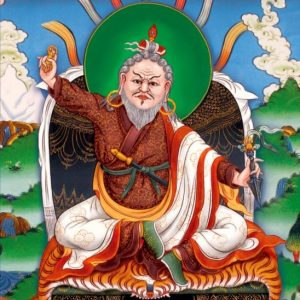
The transformative journey in Vajrayana is often described through progressive stages, categorized into four groups of tantras: Kriya-tantra, Charya-tantra, Yoga-tantra, and Anuttarayoga-tantra. These stages metaphorically represent an increasing internalization and unification of practice, moving from external rituals to deep contemplation and the ultimate unification of all dualities. Preliminaries (Ngondro) are often prerequisites for engaging in these higher tantric practices.
Navigating the Diamond Path in the Modern World
While Vajrayana offers an incredibly powerful and accelerated path, it also presents unique considerations in the modern world. Its “exotic” appeal can sometimes lead to a “consumerization” of the teachings, where individuals may seek to “collect” practices without the necessary deep commitment and responsible engagement.
A significant spiritual challenge is the risk of “ego inflation.” When practitioners visualize themselves as fully enlightened buddhas in deity yoga, there’s a danger of developing a false sense of self-importance. To mitigate this, a solid grounding in Buddhist philosophy, particularly the understanding of emptiness (shunyata) as taught in Madhyamika, is considered crucial. Without this foundational wisdom, powerful methods intended for transformation could paradoxically reinforce egoic tendencies.
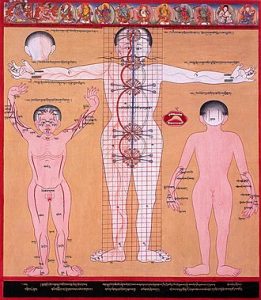
Furthermore, the efficacy and safety of Vajrayana practices are highly dependent on a profound relationship with a genuine, realized tantric teacher and full devotion to that teacher. Advanced yogic practices, such as tsa lung trul khor (yantra yoga) and tummo, carry inherent “psycho-physio-spiritual” dangers if not performed under strict, qualified guidance, potentially leading to physical harm or psychological problems.
 Despite these complexities, Vajrayana Buddhism continues to thrive globally, including in the West. Its emphasis on direct experience, embodied practice, and the profound integration of wisdom and compassion offers a compelling and transformative path for those seeking accelerated spiritual awakening in the contemporary world. The “Diamond Vehicle” remains a testament to the dynamic and adaptive nature of Buddhist wisdom, continually guiding practitioners towards the realization of their inherent enlightened nature.
© Satipatthana Magazine