
THE RETURN OF THE “PRECIOUS KING”: A 1959 ARCHIVE
In March 1959, a tremor was felt across the Buddhist world. The 14th Dalai Lama, the spiritual and temporal heart of Tibet, was forced to flee his homeland as Lhasa fell under siege. While the world watched the unfolding political crisis, the Times of Ceylon published a deep dive into the identity of this “remarkable personality.”
We are proud to republish this article from April 8, 1959. It serves as more than just a news report; it is a spiritual testament to the traditional process of finding an Incarnation—a journey involving state oracles, vision-filled lakes, and a two-year-old child who recognized his predecessor’s rosary in a humble peasant kitchen.
Why this matters to Satipatthana As a journal dedicated to the Dhamma, we believe this archive is vital for two reasons:
-
Preserving Heritage: The article captures the “Old Tibet” before its traditional structures were irrevocably altered.
-
The Global Dhamma: The events of 1959 led to the Tibetan diaspora, which paradoxically resulted in the flourishing of Tibetan Buddhism across the globe, reaching seekers from the West to the heart of Sri Lanka.
By understanding how the Dalai Lama was “found,” we connect with the continuity of a lineage that has become a symbol of peace and compassion for all humanity.
The Article: “And so the Dalai Lama was found”
(Original text from the Times of Ceylon, 08.04.1959)
The newspapers these days are full of the news that the People’s Republic of China has bombed Lhasa, that thousands of Chinese troops are marching into Tibet to take over effective control of the people and government of Tibet and that the Dalai Lama the temporal and spiritual ruler of Tibet, a country as large as Spain France and Germany put together and fled the capital and entered India seeking political asylum in that country.
The present Dalai Lama is a remarkable personality who though only 24 years of age, is reputed to have intelligence , wisdom and understanding far above his age. At no time had any Dalai lama inspired so much confidence and hope in the people of Tibet as the present Dalai Lama . But alas, fate does not appear to have been kind to him, for this is the second time he has had to flee the capital. The first time was in 1950 when Chinese troops entered Tibet and threatened Lhasa.
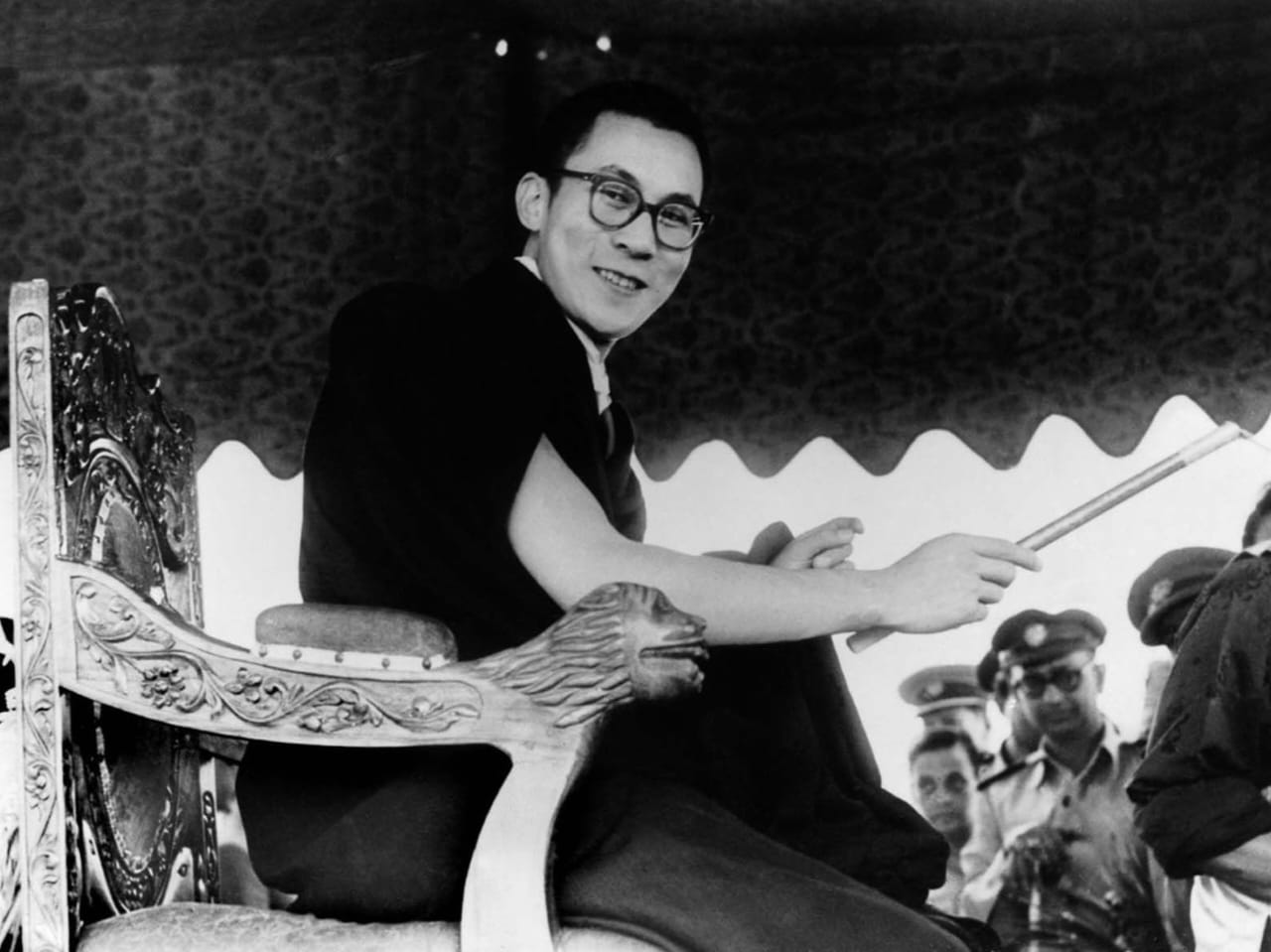
![]() The Dalai Lama, age 24, blesses a crowd gathered for a ceremony in Calcutta, India during his visit to participate in the 2,500th Buddha Jayanti celebrations. 1957.
The Dalai Lama, age 24, blesses a crowd gathered for a ceremony in Calcutta, India during his visit to participate in the 2,500th Buddha Jayanti celebrations. 1957.
He is the 14th incarnation. The people of Tibet regard him as the living Buddha rather than as a king and their prayers are directed to him not as ruler so much a patron god of the land. He represents in his person the return to earth of Chemexi was the patron god of one of the thousand living Buddhas, who have renounced Nirvana in order to help mankind Chenrai was the patron god of Tibet and his reincarnations were always the kings of Bo. as the natives call Tibet. The Mongolian ruler. AltanKhan, who hsd embraced Buddhism, gave the title of Dalai lama to the incarnation.
The present Dalai Lama was born on June 6th 1935, in Amdo in the neighbourhood of lake Kuku Nor. And it will no doubt be of interest to the reader to know the circumstances and manner in which the present Dalai lama came to be recognized as an Incarnation.
Before Death
Sometimes before his death in 1933, the 13th Dalai lama had given intimation as regards the manner of his rebirth. After his death, the body lay in state in the Potala palace in Lhasa in traditional Buddha posture looking towards the south. One morning it was noticed that his head was turned towards the east. The state oracle was straightaway consulted and while in his trance, the monk oracle threw a white scarf in the direction of the rising sun. But for two years nothing more definite was indicated.
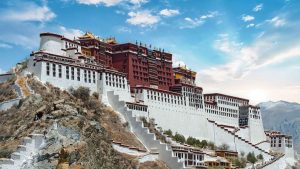 TIBET: LHASA. The Tibetan capital and Potala Palace, home of His Holiness the Dalai Lama
Then the regent went on a pilgrimage to a famous lake to ask for counsel. It was said that every person who looked into the waters of Cho Khor Gye can see a part of the future. When the Regent, after long prayers, came to the water and looked in its mirror he had a vision of a three-storeyed monastery with olden roofs, near which stood a little Chinese peasant house with carved gables. Full of gratitude for the divine direction, he returned to Lhasa and began pre-parations for a search. The whole nation took a lively interest in the business, feeling itself an orphan with no divine patron to protect it.
With us it is generally, but mistakenly, believed that each rebirth takes place at the moment of the predecessor’s death. This does not accord with Buddhist doctrine, which declares that years may pass before the god once more leaves the fields of Heaven and resumes the form of man.
Search groups set out to explore in the year 1937. Following thesign which had been vouchsafed they journeyed east ward in quest of the Holy Child. The members of these groups were monks and each group there was one secular official. They all carried with them objects that had belonged to the 13th Dalai Lama.
One such group, under the leadership of Kyetsang Rimpoche, journeyed to the district of Amdo in the Chinese province of Chinghai. In that region there were many monasteries as the great reformer of Lamaism. Tsong Kapa, was born there. The population is partly Tibetan and lives peacefully side by side with the Muslims. The group found a number of boys but none of them corresponded to the specification. They began to fear that they would fall in their mission.
At last, after long wanderings they encountered a three storeyedmonastery with golden roofs. With a flash of enlightenment they remembered the Regent’s vision and then their eyes fell on the cottage with carved gables. Full of excitement they dressed themselves in the clothes of their servants. This manoeuvre is customary during these searches, for persons dressed as high officials attract too much attention and find it hard to get in touch with the people.
The servants dressed in the garments of their masters, were taken to the best room while the disguised monks went into the kitchen where it was likely they would find the children of the house.
As soon as they enter the house, they felt sure that they would find the Holy Child in it and they waited tensely to see what would happen. And sure enough, a two-year-old boy came running in to meet them and seized the skirts of the Lama, who wore round his neck the rosary of the 13th Dalai Lama. Unabashed the child cried “Sera Lama, Sera Lama”. It was already a matter of wonder that the infant recognized a Lama in the garb of s servant and that he said that he came from the monastery of Sera which was the ease. Then the boy grasped the rosary ans tugged at it till the Lama gave it to him. Thereupon he hung it round his neck. The noble searchers found it hard not to throw themselves on the ground before the child as they had no longer any doubt. They had found the Incarnation but they had to proceed in the prescribed manner.
The Return
They bade farewell to the peasant family, and again returned a few days later this time not disguised. They first negotiated with the parents who had already given one of their sons as an Incarnation of the Buddhas to the church. This was Rimpochewho was vested with the dignity of Lama in the monastery of Togtsel. The little boy was awakened from his sleep and the four four delegates withdrew with him to the altar room. Here the child was subjected to the prescribed examination. He was first shown four different rosaries, one of which the most worn , had belonged to the 13th Dalai lama. The boy who was quite unconstrained and not the least bit shy chose the right one without hesitation and danced round the room with it.
He also selected out of several drums one which the last Incarnation had used to call his servants, then he took an old walking stick, which had also belonged to him, not deigning to bestow a glance on one which had a handle of ivory and silver. When they examined his body they found all the marks which an Incarnation of Chenrexi ought to bear: large, outstanding ears, and moles in the trunk which were supposed to be traces of the four-armed god’s second pair of arms.
Now Sure
The delegates were now sure that they had found what they sought. They telegraphed in a secret code via China and India a message to be conveyed to Lhasa and immediately received instructions to observe the utmost secrecy to avoid intrigues which might imperil the success of their mission. The four envoys took a solemn oath of silence before a ‘thanta’ on which a likeness of Chenrezl was embroidered and then went off to inspect other boys as a blind.
One must remember that the search was being conducted on Chinese territory which made caution essential. It would have been fatal to to betray the fact that the Dalai Lama had been discovered, for the Chinese could then have insisted on sending an escort of troops with him to Lhasa. The delegates accordingly asked the Governor of the province a certain Ma Pufang, for permission to take the boy to Lhasa, where the Dalai lama would be identified out of a number of candidates.
Ma Pufang asked for 100,000 Chinese dollars for the surrender of the child and this was at once paid over. This was a mistake as the Chinese now perceived what importance the Tibetans attached to the child. They then asked for another 300,000 dollars.
Part Sum
The delegates conscious of their previous mistake only gave a part of this sum which they borrowed from local Mohammedenmerchants, promising to pay the balance when they came to Lhasa to the merchants who accompanied the caravan. The Governor agreed to this arrangement.
In the late summer of 1939 the four delegates together with their servants, the merchants the Holy child and his family started for Lhasa. They travelled for months before reaching the Tibetan frontier. There a Cabinet Minister was waiting for them with his staff. He gave the boy a letter from the Regent containing official confirmation of his recognition. Then for the first timehomage was paid to him as Dalai Lama. Even his parents who had certainly guessed that their son must be a high Incarnation, only now learnt that he was no less than the future ruler of Tibet.
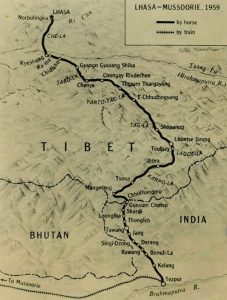
His Holiness the Dalai Lama’s 1959 escape route to India
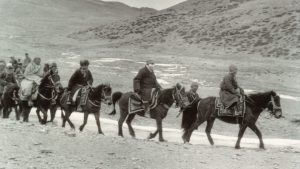 His Holiness the Dalai Lama on horseback or surrounded by his guards and Indian officials as he reached safety to India in 1959